


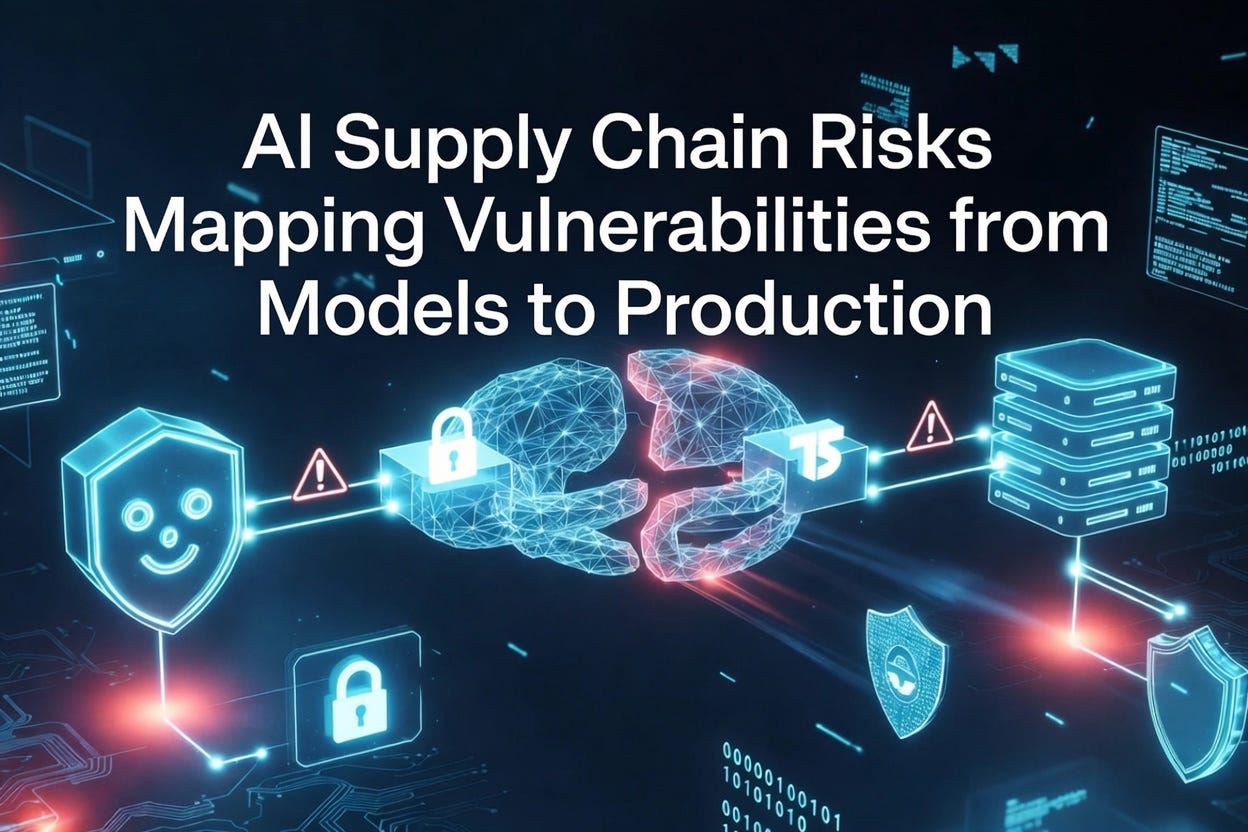
In the rush to adopt AI, organizations are ingesting components from open model hubs, pulling in sprawling dependency graphs, and wiring up third-party services at breakneck speed. What looks like rapid innovation is often a widening attack surface—one that traditional software supply chain defenses only partially cover.
As someone deeply involved in Microsoft security products and AI agent work, I’ve seen how these risks move from theoretical to operational very quickly. This post maps the key vulnerabilities across the AI supply chain and offers practical steps to harden your deployments.
The Expanding AI Supply Chain Attack Surface
AI systems are rarely built in isolation. A typical production deployment might include:
Pre-trained models from repositories like Hugging Face
Frameworks and libraries (PyTorch, TensorFlow, and their ecosystems)
Data pipelines and datasets
Third-party APIs, agents, MCPs (Model Context Protocols), plugins, and orchestration tools
Runtime environments with GPU drivers, containers, and inference servers
Each layer introduces potential compromise points. Unlike traditional software, AI artifacts can carry risks not just in code but in weights, serialized formats, training data, and even emergent behaviors.
1. Risks in Open-Source Model Repositories
Public hubs like Hugging Face are treasure troves—but also hunting grounds. Researchers have repeatedly found malicious models containing backdoors via unsafe serialization formats like Python’s Pickle. Loading a seemingly benign .bin or .pkl file can execute arbitrary code on the host system.
Real-world examples:
Malicious models uploaded to Hugging Face that evaded initial scans and enabled remote code execution or data exfiltration.
Account impersonation and model poisoning where attackers gain control of seemingly trusted repositories and inject C2 (command-and-control) capabilities.
Vulnerabilities in libraries like Hugging Face Transformers and Diffusers that allowed trust_remote_code bypasses, executing attacker-controlled code even when safeguards were explicitly disabled.
Models aren’t just files; they can be living attack vectors once loaded into inference pipelines.
2. Dependency and Framework Vulnerabilities
AI projects often have deeper, more opaque dependency trees than traditional apps. One compromised package can cascade across training, fine-tuning, and deployment pipelines.
Notable incidents include:
The torchtriton dependency hijack in PyTorch nightlies (typosquatting/dependency confusion leading to data exfiltration).
AI-generated code hallucinating non-existent (or malicious) packages, with studies showing ~20% of referenced dependencies in LLM-generated code pointing to phantom or risky libraries.
Transitive dependencies in ML frameworks, data processing libs, and container images multiply the risk. GPU drivers and inference runtimes add another layer that’s frequently overlooked.
3. Third-Party Integrations and Runtime Risks
Production deployments rarely stop at a single model. RAG pipelines, agent frameworks, external APIs, and plugins introduce ongoing risks:
Insecure deserialization during inference
Exposed endpoints without proper auth/rate limiting
Shadow AI and unmanaged MCPs or connectors
Supply chain compromises in upstream services (e.g., compromised libraries injected into widely used AI tools)
Third-party data sources for training or retrieval can also introduce poisoned data, leading to backdoors or manipulated outputs that persist into production.
Mapping and Mitigating the Risks
Key practices for 2026 and beyond:
Adopt AI Bill of Materials (AIBOM) and enhanced SBOMs Track models, datasets, dependencies, and provenance. Treat models like critical software artifacts with versioned lineage, signatures, and integrity checks.
Secure model ingestion and loading
Prefer safe formats like Safetensors over Pickle where possible.
Scan all models with tools specialized for ML artifacts (malware, pickle, secrets scanning).
Enforce trust_remote_code=False rigorously and validate configurations.
Use isolated environments (sandboxed loading, air-gapped evaluation) for untrusted models.
Dependency and supply chain hygiene
Pin versions, use private mirrors, and scan for typosquatting/dependency confusion.
Implement reproducible builds and reproducible training pipelines.
Monitor for hallucinated dependencies in AI-assisted code.
Runtime and deployment controls
Apply Zero Trust principles: least privilege, continuous validation, network segmentation for inference endpoints.
Monitor for anomalous behavior in models (e.g., unexpected outbound connections, resource spikes).
Integrate with Microsoft Defender for Cloud, Microsoft Sentinel, and Security Copilot for unified visibility across AI workloads.
Use AI-specific posture management to track model genealogy and risks.
Governance and culture
Educate teams on AI supply chain specifics (different from traditional AppSec).
Require vendor due diligence, security attestations, and SLAs for third-party AI services.
Implement policy-as-code for model approvals and deployments.
Why This Matters Now
AI supply chain attacks are evolving from opportunistic malware drops to sophisticated, persistent compromises that target the unique properties of models and data. The speed of AI adoption often outpaces security controls, creating windows attackers are already exploiting.
Organizations that treat AI components with the same rigor as their core software supply chain—while adding ML-specific defenses—will gain a significant resilience advantage.
What’s next?
Start by auditing one production AI workload: map its full supply chain, scan the models and dependencies, and implement basic AIBOM tracking. Tools in the Microsoft ecosystem (Purview for governance, Defender for threat detection, Sentinel for correlation) can accelerate this significantly.
If you’re building or securing AI agents, models, or MLOps pipelines, I’d love to hear your experiences—drop a comment or connect on LinkedIn/X. For deeper dives into Microsoft-specific defenses, check my other posts on Defender XDR, Sentinel, and AI agent hardening.
Stay vigilant. Build securely.