


Databricks’ 2026 State of AI Agents report, built from anonymized telemetry across more than 20,000 customers including a large share of the Fortune 500, found that multi-agent workflows jumped 327% in four months as teams moved past isolated copilots and into systems that plan, delegate, and execute. That is the fastest-growing slice of enterprise agent work, and it is not a curiosity metric. It is what happens when a single model stops being able to hold the whole job.
Gartner put multiagent systems on its 2026 list of top strategic technology trends for the same reason: modular agents can collaborate on complex tasks and make automation reusable at enterprise scale. The practical question is no longer whether to use multiple agents. It is how to coordinate them without creating a system you cannot explain, debug, or trust.
Why one agent stops being enough
A single agent is a good fit for a bounded task. Summarize this ticket. Draft this email. Query this table. The moment the work spans domains, tools, policies, and handoffs, that agent becomes a generalist with a bloated prompt and an unreliable memory.
Specialists beat generalists on accuracy, cost, and reuse. A retrieval agent can stay close to the data plane. A policy agent can stay close to the control plane. A coder can stay close to the repo. A reviewer can stay close to the checklist. Each one can use a different model, a different tool set, and a different set of permissions.
That is the promise Gartner is pointing at: divide the work, reuse the pieces, scale the automation. It is also why coordination becomes the product.
Without an orchestration layer you do not have a system. You have a pile of agents that share a budget line.
The supervisor pattern became the default for a reason
The pattern showing up everywhere is simple to describe and hard to operate well.
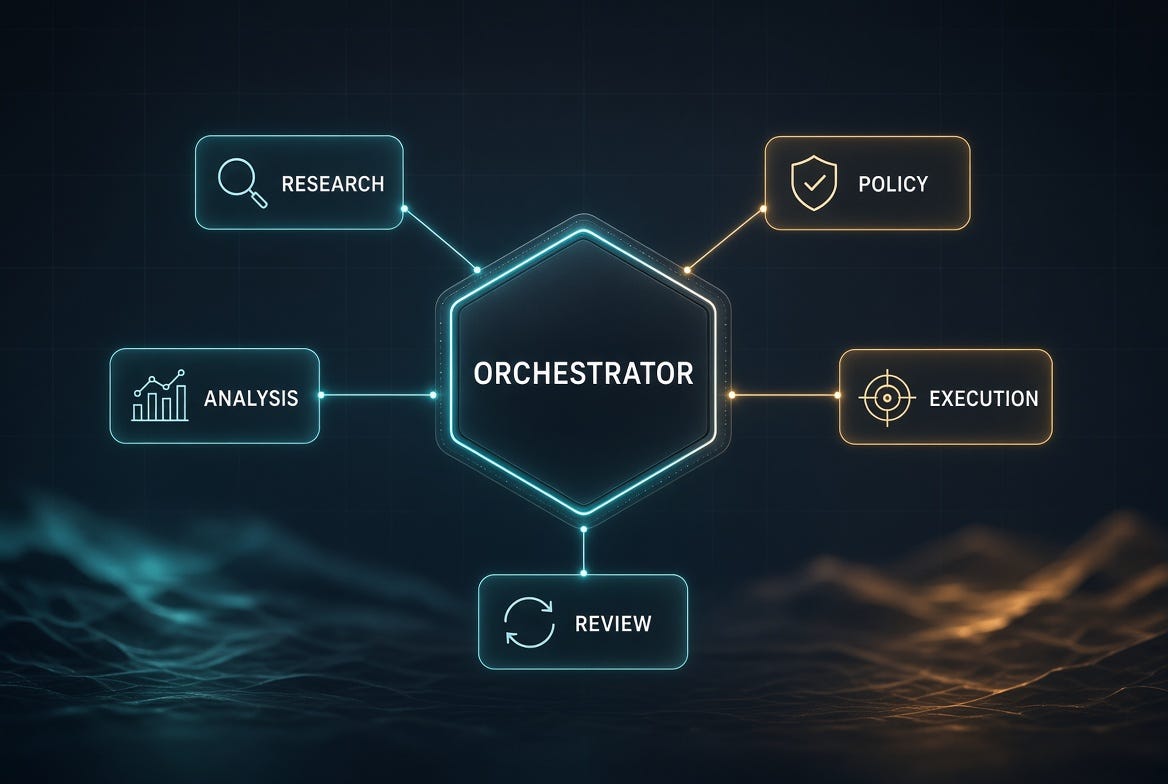
A supervisor, or orchestrator, sits at the front door. It interprets intent, breaks the request into subtasks, routes work to specialists, tracks state, retries failures, and synthesizes a single answer. Workers do not need to know about each other. The supervisor does.
Databricks saw this show up immediately in platform usage. After it launched a Supervisor Agent in mid-2025, that pattern became the leading use case and a large share of activity within a few months. Other platforms are shipping the same shape under different names: supervisor mode, planner-worker, hierarchical teams, front-door orchestrators.
Enterprises like it because it maps to how they already run work. One accountable owner. Specialists underneath. A traceable decision chain. Auditors can follow who decided what. Security teams can put identity, logging, and policy at a single choke point instead of hoping a mesh of peer agents behaves.
That is why supervisor and orchestrator designs are becoming the default for anything beyond a single bounded task. Not because they are theoretically optimal, but because they are operationally understandable.
They are not free.
A supervisor that reasons on every hop adds latency and token cost. It can become a bottleneck. If the supervisor is vague, specialists drift. If the supervisor is too eager, the system loops. If the merge step is weak, you get a polished answer assembled from contradictory parts.
Other patterns exist for a reason. A fixed pipeline is faster and cheaper when the steps rarely change. Parallel fan-out is better when you need many sources at once. Debate helps when the cost of being wrong is higher than the cost of a second opinion. Hierarchical supervision helps when the work is large enough that one orchestrator cannot hold the plan.
The mistake is treating supervisor as a personality type instead of a fit-for-task choice. Match the pattern to the shape of the work.
Complexity does not arrive as a feature. It arrives as sprawl.
The growth numbers hide the operating reality.
Databricks also reported that only 19% of audited organizations had deployed agents at scale. Experimentation is cheap. Production is not. Salesforce’s 2026 connectivity research found IT leaders already staring at agent sprawl: an average of about 12 agents per enterprise, heading toward 20, sitting on top of hundreds of applications that are still poorly connected. Most of those leaders expect more complexity than value unless integration and data access get fixed.
Gartner’s own planning assumptions make the coordination tax explicit. By 2027, it expects most multiagent systems to use narrow, focused agent roles. That improves accuracy. It also increases the number of handoffs. By 2028, it expects a majority of those systems to mix agents from multiple vendors once communication protocols settle. That improves flexibility. It also multiplies trust boundaries.
This is the part vendors underplay. Adding agents is easy. Adding agents without a coordination architecture is how you recreate every distributed-systems failure in natural language:
Context-handoff decay. The second agent never receives what the first agent actually knew.
Role drift. A specialist starts doing the supervisor’s job, or the supervisor starts doing the specialist’s job.
Merge conflicts. Two agents return incompatible facts and nobody is assigned to adjudicate.
Task duplication. Three agents solve the same subtask because the plan was implicit.
Infinite loops. The orchestrator keeps replanning because “done” was never defined.
Privilege bleed. A low-trust worker inherits the supervisor’s tools because the identity model is “the agent.”
Research on production multi-agent LLM systems keeps landing in the same place: a large share of failures are coordination defects, not base-model stupidity. Planning, state, verification, and handoff quality decide whether the system holds.
If you work in security, this should sound familiar. You already know what happens when services talk to each other without identity, contracts, or telemetry. Multi-agent systems are distributed systems with probabilistic components. Treat them that way.
Orchestration is a control plane, not a prompt
The teams that will survive this wave are the ones who stop thinking of orchestration as a clever system prompt and start treating it as architecture.
A usable coordination layer needs seven things specified on purpose, not discovered in production:
Endpoints and contracts. Each agent has a job, an input schema, an output schema, and a refusal path. “Helpful generalist” is not a contract.
Topology. Who is allowed to talk to whom. Supervisor-to-worker is a star. Peer-to-peer is a mesh. Meshes are exciting until you have to reconstruct a decision.
Authority. Who can finalize, who can only recommend, who can call tools that change state.
State. What persists across steps, where it lives, and how long it is trusted. Chat history is not a system of record.
Aggregation. How outputs combine. First-valid, supervisor-synthesis, majority, policy-gated merge. Pick one and test it.
Termination. Success criteria, max steps, max spend, max time, and what happens when the plan is exhausted.
Failure policy. Timeouts, malformed output, tool errors, disagreement, and escalation to a human. Silence is not a policy.
Do that and the supervisor pattern becomes an asset. Skip it and the supervisor becomes a narrator for chaos.
Governance is not a later phase. Databricks found a blunt correlation: organizations using governance tooling got far more projects into production than those that did not. Control is not the thing you add after the demo lands. It is the difference between a reusable platform and a collection of brittle bots.
For security-minded teams, the same control plane should include:
Per-agent identity, not a shared service principal for the whole fleet.
Least privilege on tools. A research agent does not need write access to production.
Signed, replayable traces for every handoff.
Policy checks before state-changing actions, not after the email goes out.
Budget and rate limits so a retry storm cannot become an invoice event.
A human-on-the-loop path for irreversible or regulated steps.
If you cannot answer “which agent did this, with which tool, under which policy, using which data,” you do not have orchestration. You have automation with extra steps.
How to grow multi-agent systems without drowning in them
Start narrower than the architecture diagrams on vendor slides.
Use one well-scoped agent until the task actually requires a second skill, a second trust boundary, or a second source of truth. Then add a specialist and an orchestrator, not a committee.
Keep workers boring. The more reusable an agent is, the less it should know about the global plan. Give it a self-contained subtask. Take a structured result back. That is how you get modularity instead of a distributed group chat.
Prefer deterministic scaffolding around probabilistic parts. If 80% of a workflow is a known sequence, encode that sequence. Let the supervisor handle the exceptions. A lot of production pain comes from using a reasoning loop for work that should have been a pipeline.
Instrument the seams. Log the plan, the route, the tool calls, the tokens, the retries, and the merge. When something fails, you want the handoff that lost the plot, not a 40-page transcript.
Design for vendor mix even if you are standardizing today. Gartner’s 2028 assumption is not a fashion forecast. It is a warning that your orchestrator will eventually sit in front of agents you did not train and tools you do not own. Contracts and identity matter more than framework loyalty.
And keep a human in the places that still require judgment. Multi-agent systems are excellent at decomposition, retrieval, drafting, and routine execution. They are weaker at knowing when the plan itself is wrong. That is still a leadership problem, not a model problem.
The default is forming. The discipline is not.
Multi-agent systems are the growth story of 2026 because they match how enterprises actually work: specialized roles, reused capabilities, and a coordinator that turns intent into action. Supervisor and orchestrator patterns won the early standard because they give you a place to put control.
The risk is that teams copy the org chart into prompts and call it architecture. Growth without coordination produces agent sprawl, silent failure, and automation you cannot defend in an incident review.
Build the control plane first. Then add specialists. Then scale the fleet.
That is how you get modular, reusable automation instead of a faster way to lose the plot.