

Quantum Computing Meets Generative AI: The Dawn of Quantum-Enhanced Creativity
When Qubits Go Rogue – Finally, an AI That Can Hallucinate Faster and Weirder Than You Do

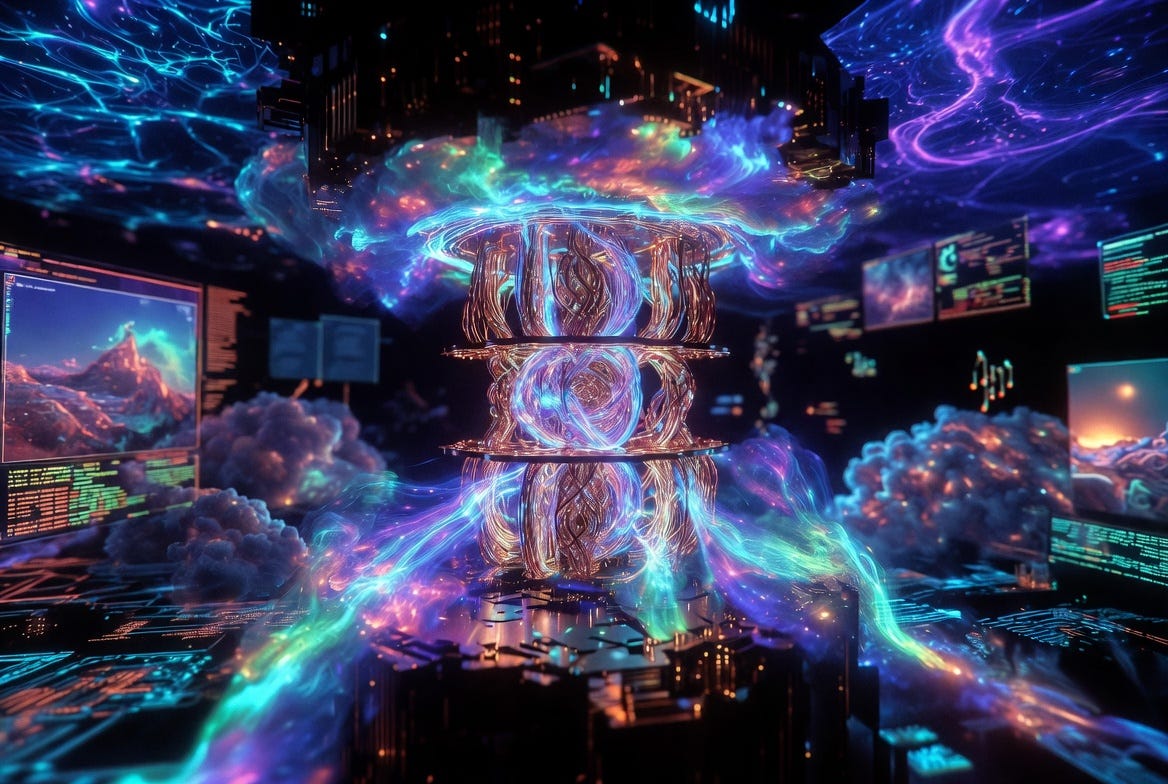
Generative AI has already transformed how we create—turning text prompts into photorealistic images, symphonies, or novels faster than you can say “DALL-E.” But it’s hitting walls: training is compute-hungry, outputs can be repetitive or biased, and sampling diverse, high-quality results in vast possibility spaces remains slow.
Enter quantum computing. With its superposition, entanglement, and inherent probabilistic nature, quantum hardware promises to supercharge models like GANs (Generative Adversarial Networks) and diffusion models. We’re talking faster convergence, richer diversity, and creativity that feels truly alien. This isn’t sci-fi—researchers are already demonstrating hybrid quantum-classical systems outperforming pure classical ones in image generation, molecular design, and more.
Why Quantum? The Superpowers for Generative Models
Classical computers process bits one at a time. Quantum bits (qubits) can exist in multiple states simultaneously (superposition) and correlate instantly across distances (entanglement). This makes them natural for exploring enormous probability distributions—the heart of generative AI.
Better Randomness and Sampling: Classical noise is pseudo-random. Quantum measurements provide true randomness. Studies show injecting quantum randomness into GANs improves realism in generated images.
Handling High-Dimensional Spaces: Diffusion models (like those powering Stable Diffusion) gradually denoise data. Quantum versions, such as Quantum Denoising Diffusion Probabilistic Models (QuDDPMs), leverage quantum noise resilience and parallel exploration for more stable, efficient training—especially promising as classical diffusion scales poorly.
Hybrid Approaches Dominate (for Now): Fully fault-tolerant quantum computers are years away (NISQ era limitations), so hybrid QGANs—quantum generator + classical discriminator—are leading. IonQ’s work on steel microstructure images showed quantum-enhanced GANs scoring higher quality in up to 70% of cases.
Supercharging Images: From Pixels to Quantum Masterpieces
Imagine generating not just variations, but entirely novel artistic styles or photorealistic scenes with quantum-level diversity. QGANs replace parts of neural nets with quantum circuits, using parameterized quantum circuits (PQCs) for the generator.
Early demos on MNIST digits and beyond show quantum models capturing complex patterns more parameter-efficiently. Recent quantum diffusion models are tackling facial image generation on complex datasets. The result? Faster iteration, less mode collapse (where GANs get stuck repeating similar outputs), and outputs that explore the “long tail” of creativity.
Music and Text: Composing in Quantum Harmony
Music: Quantum interference and Markov chains driven by quantum states enable real-time improvisation or novel compositions. Quantum generative models can sample intricate probabilistic sequences for melodies or harmonies that classical models might miss.
Text and Beyond: While LLMs are classical beasts, quantum-enhanced generative models could optimize embeddings or sampling in latent spaces for more coherent, diverse narratives. Quantum circuits for state tomography and data generation are already feeding into broader AI pipelines.
Applications extend to drug discovery (quantum gen models outperforming classical for viable molecules) and materials science—proving the tech’s real-world bite.
Challenges on the Horizon
Don’t cancel your GPU subscription yet. NISQ devices are noisy and limited in qubits. Training hybrid models requires clever error mitigation, and scaling to useful sizes demands breakthroughs in error correction. Full quantum advantage for massive generative tasks (think billions of parameters) is still emerging, with Google Quantum AI showing promising “generative quantum advantage” proofs.
Energy and accessibility are other hurdles—quantum hardware isn’t in your basement (yet).
The Dawn of Quantum Creativity
Quantum-enhanced generative AI could democratize ultra-high-fidelity creation: instant, diverse content for artists, musicians, writers, and industries. Picture AI agents dreaming up entire worlds with quantum speed, or personalized medicine via quantum-designed molecules.
As hybrid systems mature and fault-tolerant quantum hardware arrives, we’ll look back on today’s classical generative AI as quaint. The qubits are coming—and they’re ready to create.
What do you think—will quantum make AI too creative, or just right? Drop your thoughts below.