


Happy 250th Birthday, America!
As we mark the United States’ Semiquincentennial — a quarter-millennium of independence, innovation, and unbreakable spirit — we celebrate the enduring ideals of liberty, ingenuity, and resilience that have defined our nation since 1776. From the revolutionary spark in Philadelphia to our position today as a global leader in technology and enterprise, America continues to push boundaries while confronting new challenges head-on. In the spirit of vigilance that has always protected our freedoms, this week’s security Quick Hits remind us that safeguarding our digital infrastructure is essential to preserving the prosperity and security we’ve built over 250 remarkable years.
Here are the latest critical developments you need to know:
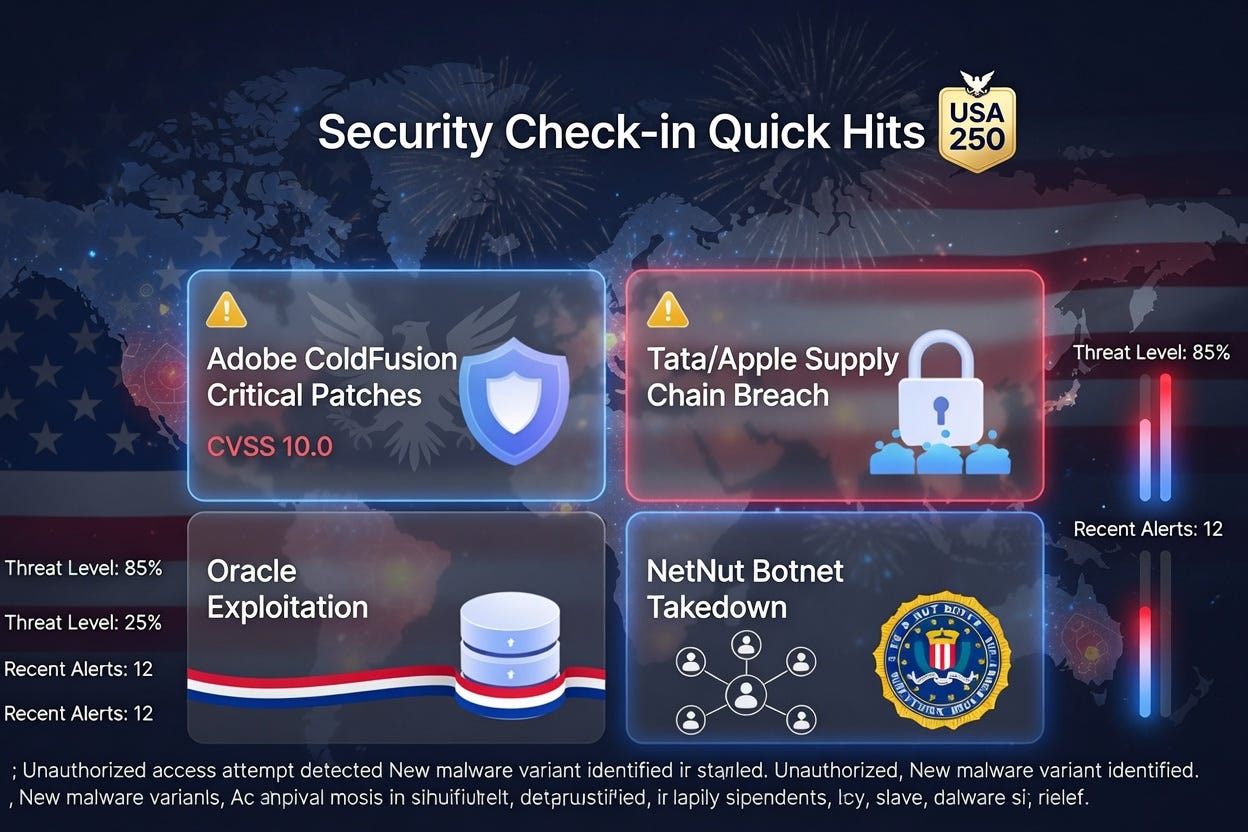
Adobe’s Emergency Patches for 7 Critical (CVSS 10.0) Flaws in ColdFusion & Campaign Classic
Adobe has released urgent security updates addressing multiple maximum-severity vulnerabilities, including unauthenticated remote code execution risks in ColdFusion and Campaign Classic. These flaws could allow attackers to compromise embedded or on-premises systems widely used in enterprise environments.
Key Details: Several CVSS 10.0 issues involve incorrect authorization and unrestricted file uploads. Users of affected versions should patch immediately—exploitation could lead to full system takeover. This highlights the ongoing risks in widely deployed content management and marketing tools. Organizations relying on these should prioritize updates and monitor for signs of pre-patch compromise.
Takeaway: Critical vulnerabilities in foundational software continue to demand rapid response. Delay here could be catastrophic for IoT-adjacent or web-heavy deployments.
Tata Electronics Data Breach Exposes Apple iPhone 18 Pro Secrets
India is investigating a significant data breach at Tata Electronics (a key Apple supplier), where a ransomware group (reportedly World Leaks) allegedly leaked over 630GB of data, including documents on unreleased iPhone 18 Pro components, supplier lists, A20 Pro chip specs, and more.
Key Details: The incident, confirmed by Tata, involved sensitive supply chain files. Apple and Indian authorities (including CERT-In) are involved. Production continues, but the leak raises concerns about intellectual property theft and risks to India’s growing role in global iPhone manufacturing.
Takeaway: Supply chain attacks remain a high-impact vector. Third-party vendors handling proprietary tech data are prime targets—strong segmentation, monitoring, and incident response are essential. This also spotlights geopolitical and economic stakes in tech manufacturing.
Medtronic Data Breach Notifications for ~3.8M Impacted Individuals
Medical device giant Medtronic is notifying individuals affected by an April 2026 cyber incident (linked to ShinyHunters claims) that impacted corporate IT systems and exposed personal/medical data for up to 3.8 million people.
Key Details: The breach involved unauthorized access; notifications are now rolling out. No impact on medical devices or patient safety systems was reported, but sensitive records were at risk. This underscores persistent threats to healthcare data.
Takeaway: Healthcare remains a lucrative target due to high-value data. Organizations should focus on credential hygiene, segmentation, and timely breach disclosure to mitigate regulatory and reputational harm.
Active Exploitation of Critical Oracle E-Business Suite Vulnerability (CVE-2026-46817)
Threat actors are rapidly exploiting a critical flaw in Oracle E-Business Suite’s Payments module (File Transmission component), enabling unauthenticated file reads and potential further compromise. Exploitation was detected shortly after patching.
Key Details: The vulnerability allows HTTP-based attacks on exposed instances. Over 900 instances may be vulnerable; organizations using Oracle EBS should apply patches urgently and review logs for exploitation attempts.
Takeaway: Zero-day and N-day exploits move fast in enterprise software. Asset inventory, exposure reduction, and threat hunting are critical—especially for financial/payment systems.
FBI/Google Takedown of NetNut/Popa Botnet (2M+ Infected Devices)
A coordinated operation by the FBI, Google, and partners dismantled parts of the NetNut residential proxy service tied to the Popa botnet, which hijacked millions of consumer devices (via shady apps and cheap streaming boxes) for proxying attacks, scraping, and more.
Key Details: Domains seized; Google blocked related accounts/apps. This disrupts malicious traffic relay infrastructure and protects users from unwanted data usage/billing.
Takeaway: IoT and consumer devices are soft targets for botnets. Improved supply chain security for hardware/software and user awareness of suspicious apps are key defenses.
These “quick hits” reflect a pattern of supply chain risks, unpatched enterprise software, data exfiltration in healthcare/manufacturing, and infrastructure takedowns. Stay vigilant with patching, monitoring, and least-privilege principles.
Here’s to the next 250 years of American strength and security. Stay safe out there!