


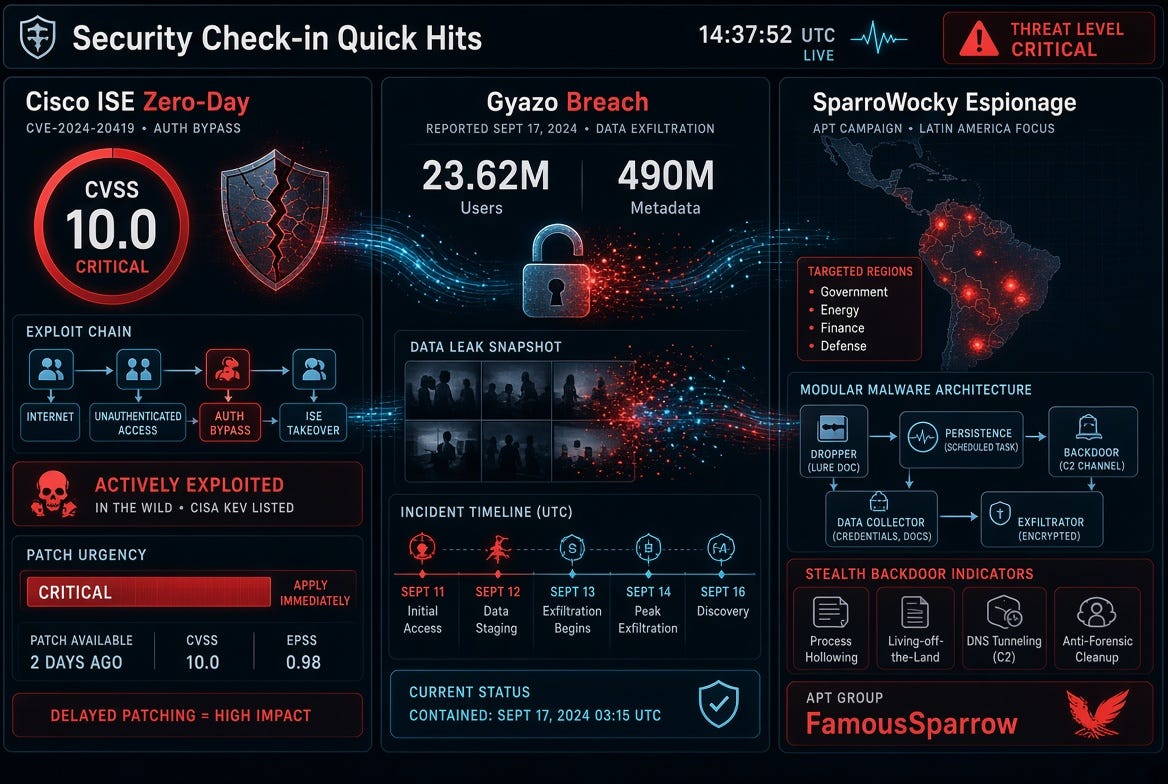
Cisco ISE Zero-Day (CVE-2026-76460): Max-Severity Auth Bypass Already Being Exploited
Cisco issued emergency patches after confirming active exploitation of a critical authentication-bypass flaw in Identity Services Engine (ISE) and ISE Passive Identity Connector. Tracked as CVE-2026-76460 with a perfect CVSS 10.0 score, the bug stems from insufficient authentication controls on an API endpoint. An unauthenticated remote attacker can simply send a crafted request and gain unauthorized access to the device by bypassing the web-based management interface entirely.
Both ISE and ISE-PIC are affected across multiple releases (roughly 3.0–3.5). There are no workarounds that fully eliminate the risk, though infrastructure access-control lists (iACLs) can limit exposure. Fixed versions include 3.1 Patch 12, 3.2 Patch 11, 3.3 Patch 12, 3.4 Patch 7, and 3.5 Patch 4. CISA added the vulnerability to its Known Exploited Vulnerabilities catalog with a short remediation window for federal agencies. Organizations running ISE should treat this as an immediate incident-response priority: patch, review access logs for suspicious usernames, and consider re-imaging compromised nodes.
Gyazo Breach: 23.62 Million User Records and Nearly Half a Billion Image Metadata Entries Exposed
Helpfeel, the Japanese company behind the popular screenshot and image-sharing service Gyazo, disclosed a significant data breach. Attackers exploited a vulnerability in the image-upload server on September 11, 2026, achieved arbitrary command execution, and accessed the database. The company contained the intrusion by September 12 and has since patched the flaw.
Confirmed exposure includes approximately 23.62 million user records (names/nicknames, email addresses, password hashes, user and device IDs, session IDs, X/Twitter integration tokens, Google SSO emails where linked, profile data, subscription details, and more). Separately, about 490 million image-metadata records—primarily for content uploaded before January 2019—were taken, including image IDs that form public URLs, IP addresses, User-Agents, EXIF location data, OCR text, and hashed passphrases for private images. No payment-card data was involved. Helpfeel is urging all users to change passwords (and any reused credentials elsewhere) and remains vigilant for secondary phishing.
FamousSparrow Deploys New SparroWocky Backdoor Against Latin American Governments
The China-aligned APT group FamousSparrow has shifted to a new modular C++ backdoor called SparroWocky (named after text from Lewis Carroll’s “Jabberwocky” found in early samples) and is heavily focusing on government targets across Latin America. ESET researchers report the malware has been in use since at least August 2025, largely replacing the group’s earlier SparrowDoor implant.
Victims span governmental organizations in Argentina, Ecuador, Guatemala, Honduras, Panama, Peru, Puerto Rico, and Venezuela. SparroWocky is a full-featured implant with strong anti-analysis techniques (memory-structure manipulation, runtime code patching), support for loading Beacon Object Files, command execution, file operations, screenshot capture, TCP proxying, and self-deletion. It often arrives via DLL side-loading and can persist through services or registry Run keys. The campaign appears tied to intelligence collection amid shifting regional geopolitics. Defenders in the region (and beyond) should watch for the associated C2 infrastructure and loader artifacts.
These three stories illustrate the day’s dominant themes: actively exploited critical infrastructure flaws, large-scale consumer-service breaches, and persistent nation-state espionage with evolving tooling. Stay patched, rotate credentials, and monitor for the indicators published by the vendors and researchers above.