


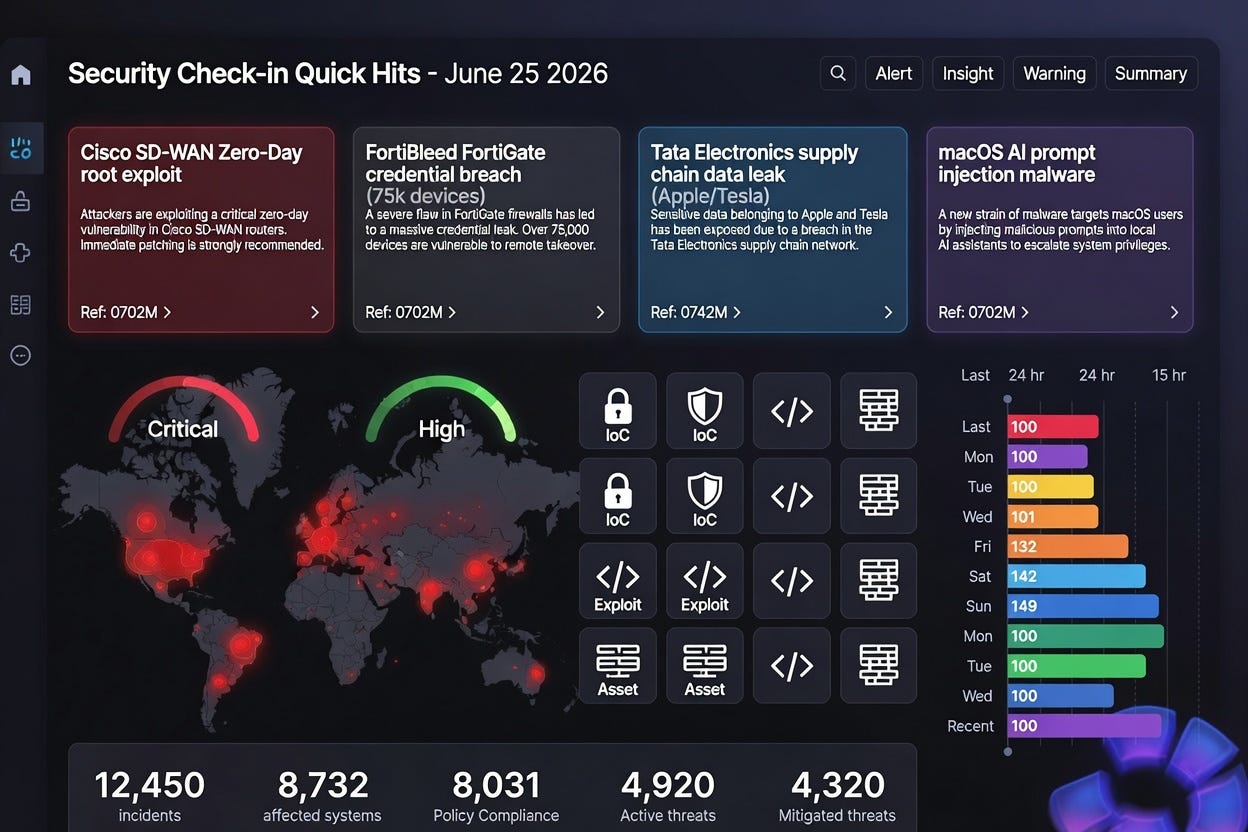
Cisco Catalyst SD-WAN Zero-Day (CVE-2026-20245) Actively Exploited for Root Access
Attackers are exploiting a critical zero-day vulnerability in Cisco Catalyst SD-WAN, allowing root-level access on affected systems. This marks the 7th such SD-WAN vulnerability exploited in 2026, with evidence of in-the-wild activity months before official patching.
Key Details: The flaw enables high-privilege access, posing risks to organizations relying on Cisco for wide-area networking and communications infrastructure. Cisco has issued patches, but delayed disclosure highlights the dangers of prolonged exposure windows.
Implications and Advice: Organizations should immediately apply patches, audit SD-WAN configurations, and monitor for indicators of compromise (IoCs). This incident underscores the need for rapid vulnerability management in enterprise networking gear.
FortiBleed Campaign: Massive Credential Harvesting Hits ~75,000 FortiGate Firewalls
A large-scale operation dubbed “FortiBleed” has compromised administrative and VPN credentials for tens of thousands of internet-facing Fortinet FortiGate devices worldwide (estimates range 30k–75k across 194 countries). Attackers used credential stuffing from prior leaks, brute-forcing, and config extraction, exposing roughly half of public FortiGate instances.
Key Details: The campaign includes automated pipelines targeting management interfaces and SSL VPN endpoints. Exposed data enables full network access for further attacks like ransomware or espionage.
Implications and Advice: Immediately rotate credentials, disable unnecessary public exposure of management interfaces, enable multi-factor authentication (MFA), and review logs for anomalous logins. This serves as a wake-up call for firewall hygiene in hybrid environments.
Tata Electronics Confirms Cyberattack with Data Leaks Allegedly Tied to Apple and Tesla
Indian electronics giant Tata Electronics (a key supplier for Apple and Tesla components) confirmed a cybersecurity incident affecting parts of its IT systems. Ransomware group WorldLeaks claimed responsibility, leaking over 200,000 files including purported trade secrets and design documents. Operations reportedly remain unaffected.
Key Details: The breach involves significant data volumes (~630GB in some reports) and highlights supply-chain risks in manufacturing and electronics sectors.
Implications and Advice: Third-party and supply-chain vendors remain prime targets. Companies should enforce strict vendor risk assessments, contractual security requirements, and continuous monitoring of partner ecosystems.
New Gaslight macOS Malware Uses Prompt Injection to Evade AI Analysis
Security researchers uncovered “Gaslight,” a Rust-based macOS information stealer and implant that embeds prompt injection payloads. These trick AI-assisted malware analysis tools into aborting or refusing to examine the sample.
Key Details: It disrupts automated and analyst workflows, representing an evolution in malware that counters AI-powered defenses. Linked to broader campaigns involving backdoors and initial access brokers.
Implications and Advice: Security teams should diversify analysis tools (human + multiple AI engines), sandbox samples carefully, and stay updated on adversarial AI techniques. This blurs lines between traditional malware and AI arms races.
Overall Takeaways: Today’s threats blend classic exploitation (zero-days, credential attacks) with emerging AI tactics and supply-chain focus. Prioritize patching, credential hygiene, network segmentation, and AI-resilient defenses. Organizations should treat public-facing infrastructure as high-risk and invest in proactive threat hunting.