

Security Check-in Quick Hits: Data Privacy, Web3 Vulnerabilities, Password Management, and Fintech Trends
For January 26, 2026

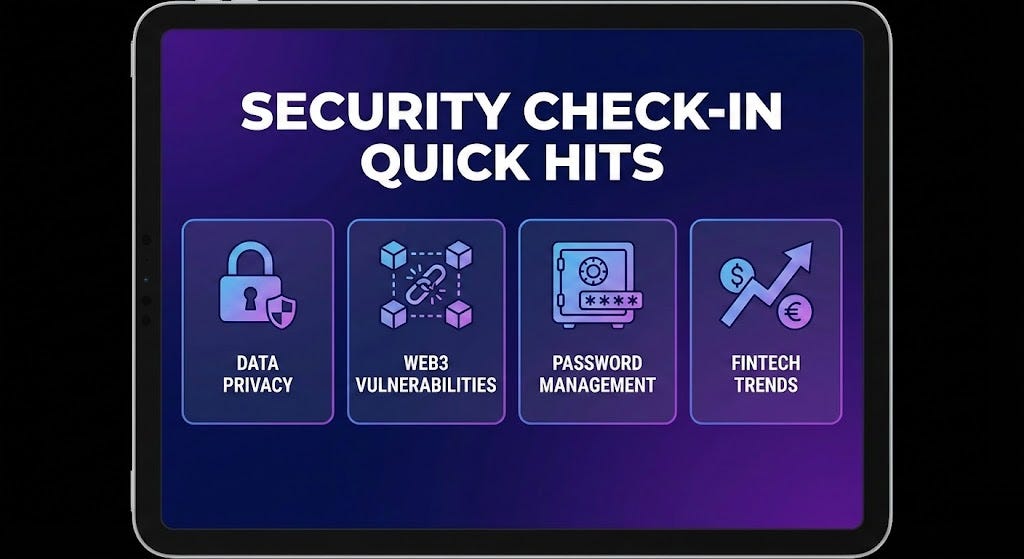
Navigating the Evolving Landscape of Data Privacy
In today’s digital age, data privacy remains a paramount concern, as highlighted by ongoing discussions and events aimed at bolstering personal data protection. With increasing reliance on online platforms, individuals and organizations face heightened risks from data breaches and unauthorized access. The upcoming Data Privacy Conference 2026 emphasizes innovative approaches to safeguarding personal information, aligning regulations, and enhancing cybersecurity measures to manage digital risks responsibly. Similarly, initiatives like Data Privacy Week encourage proactive steps to protect data, offering resources for both consumers and businesses to stay secure.
Why is this an issue now? Cyber threats are evolving, with attackers exploiting weak privacy protocols to steal sensitive information. For instance, simple actions like reviewing app permissions, using VPNs, and enabling two-factor authentication can make a big difference. Businesses should prioritize compliance with standards like GDPR or CCPA to avoid hefty fines and reputational damage.
Looking ahead, integrating AI-driven privacy tools and fostering a culture of awareness will be key. As we approach events like the 2026 conference, it’s clear that data privacy isn’t just a regulatory checkbox—it’s essential for building trust in our interconnected world. Stay vigilant: your data is your power.
Tackling Web3 and Crypto Security Challenges
The Web3 ecosystem, encompassing cryptocurrencies and decentralized applications, continues to grapple with significant security vulnerabilities, as evidenced by recent reports of massive thefts. In 2025 alone, hackers siphoned over $2.7 billion from Web3 platforms, underscoring the urgent need for robust defenses. Projects like Abatis $ABTU are stepping up, offering sovereign-grade cybersecurity tailored for crypto wallets, servers, and ecosystems, drawing from military-level tech that’s proven unhackable for over two decades.
This issue stems from the decentralized nature of Web3, which, while empowering, exposes users to phishing, smart contract exploits, and ransomware. Solutions include hardware-secured devices, quantum-resistant encryption, and proactive cyber insurance that prevents attacks rather than just mitigating damage.
For users in regions like Nigeria or beyond, adopting these tools means safeguarding assets in a high-risk environment. As Web3 grows, prioritizing security will separate thriving projects from those that falter. Remember, in crypto, security isn’t optional—it’s the foundation of trust and resilience.
Mastering Password Management for Better Cybersecurity
Remembering multiple complex passwords is a common pain point, yet it’s a critical frontline defense in cybersecurity. Weak or reused passwords are a hacker’s dream, leading to account takeovers and data leaks. Sharing tips and tricks, such as using passphrase generators or mnemonic devices, can significantly enhance security without relying solely on memory.
The core issue? Human error—people often opt for convenience over safety, like “password123.” Best practices include employing password managers (e.g., LastPass or Bitwarden) that store and autofill credentials securely, enabling unique passwords for each account. Combine this with multi-factor authentication to add layers of protection.
Organizations can promote cybersecurity by educating teams on these habits, reducing breach risks. In an era of rising cyber threats, leveling up password game isn’t just smart—it’s necessary. Pro tip: Create passwords from song lyrics or book quotes, replacing letters with numbers for added strength. Your digital life depends on it.
Emerging Cybersecurity Trends in Fintech
Fintech’s rapid evolution brings exciting innovations but also amplifies cybersecurity risks, as outlined in the top trends for 2025. With blockchain integration, digital transformation, and AI-driven services, the sector faces threats like sophisticated phishing, supply chain attacks, and regulatory compliance hurdles.
Key issues include securing decentralized finance (DeFi) platforms and protecting against ransomware that targets financial data. Trends point to increased adoption of zero-trust architectures, AI for threat detection, and collaborative ecosystems to share intelligence.
For fintech firms, staying ahead means investing in continuous monitoring and employee training. As technology advances, balancing innovation with security will define success. Watch for developments in quantum-safe cryptography and automated compliance tools. In fintech, robust cybersecurity isn’t a cost—it’s a competitive edge that builds customer confidence.