


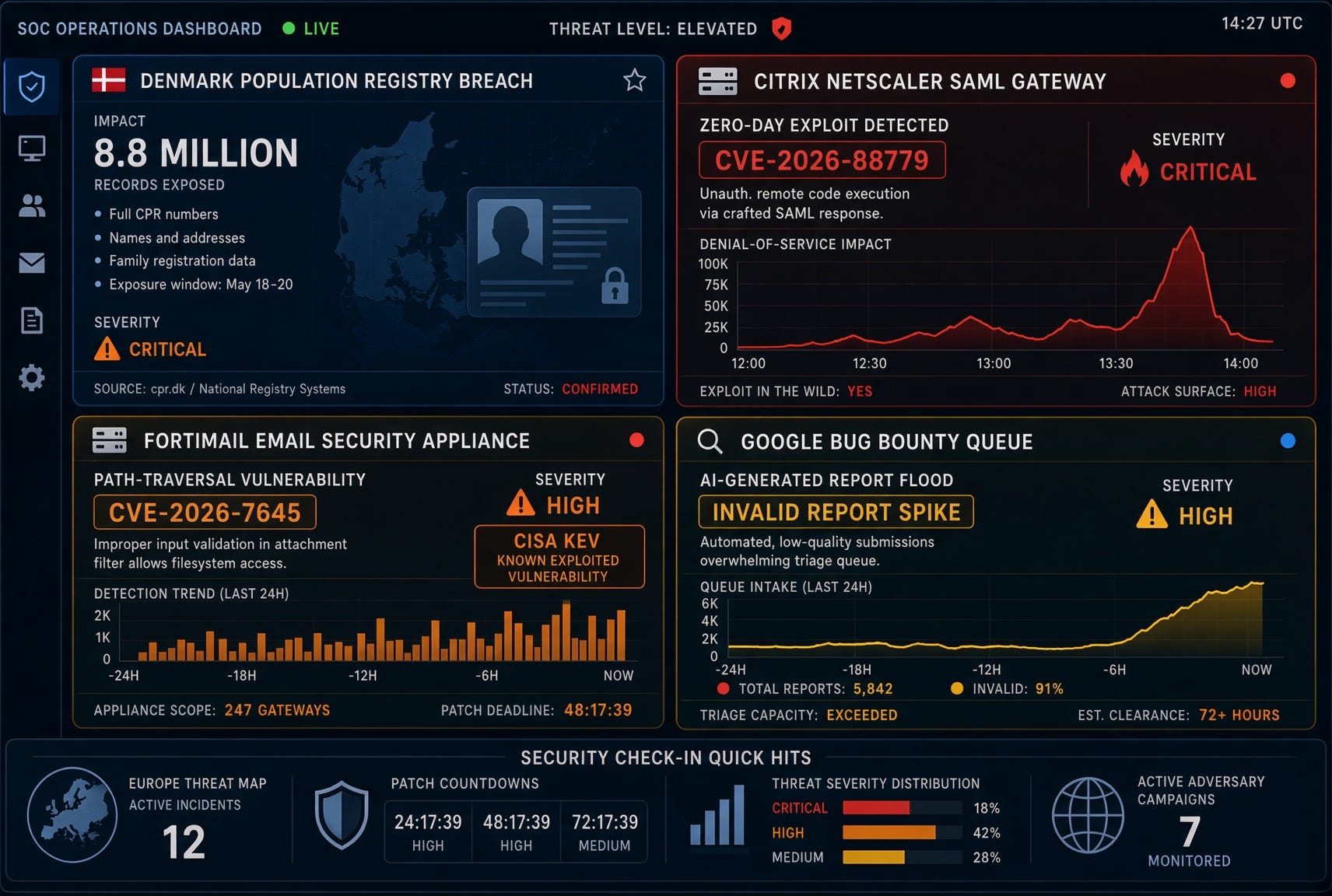
Denmark’s national register: 8.8 million records via a vendor door
Denmark confirmed on Monday that unauthorized parties reached the Central Population Register, known as CPR, and pulled personal records for about 8.8 million people. Digital affairs minister Christina Egelund called it “an extremely serious incident.” The exposed fields include names, addresses, and CPR numbers — Denmark’s social security identifiers — covering living residents plus people who have died or emigrated. Denmark’s population is about six million; the register holds closer to 11 million records, which is why the breach count exceeds the country itself.
The entry path was not a direct smash on the government database. Officials said attackers broke into a Danish company that already had legal access to the register, and that access had not been revoked when the breach was announced. Investigators do not yet know who carried it out. Euronews and Danish officials framed the case as an identity-scale incident, not a leak of passwords or medical files, but CPR numbers are enough to open fraud, impersonation, and secondary social-engineering campaigns for years.
This sits next to a separate Technical University of Denmark incident reported over the weekend, in which up to 200,000 identity-system records may have been downloaded. The two cases are not confirmed as the same operation, but they land in the same week and the same country. For defenders outside Denmark, the lesson is supply-chain access to civil registries: a vendor credential with standing query rights is as sensitive as the register itself. Revocation, session monitoring, and anomaly detection on bulk CPR lookups should be treated as production controls, not audit footnotes.
Citrix NetScaler: another SAML zero-day, already on the KEV list
Citrix shipped emergency fixes for CVE-2026-88779, a memory-overflow bug in customer-managed NetScaler ADC and NetScaler Gateway rated 8.7. Exploitation requires the appliance to be configured as a SAML service provider or SAML identity provider. Citrix says targeted attacks have already knocked unpatched SAML deployments offline, and that repeated triggers can keep the service down. The company says its analysis points to availability impact, not confirmed data-integrity loss.
Fixed builds include 14.1-73.41 and later, 13.1-64.28 and later on the 13.1 line, and the corresponding FIPS and NDcPP releases. Bishop Fox and watchTowr are credited. watchTowr said it reproduced the flaw within hours of seeing activity against NetScaler honeypots. CISA added CVE-2026-88779 to the Known Exploited Vulnerabilities catalog and set a federal remediation date of October 7, 2026.
The timing is the operational problem. This bug arrived days after CVE-2026-88771 and CVE-2026-88772 were already being used to plant web shells and tunnels on exposed appliances. Teams that patched the earlier pair and stopped watching SAML configurations are still in scope. Inventory every samlAction and samlIdPProfile binding, patch, and treat any unexplained AAA or Gateway crash on a SAML virtual server as a possible exploitation signal until logs say otherwise.
FortiMail CVE-2026-104286: unauthenticated file write, still in the news cycle
CISA’s addition of Fortinet FortiMail CVE-2026-104286 to the KEV catalog stayed in Monday’s headlines even though the catalog entry itself dates to October 1, with a federal due date of October 4. The bug is a path-traversal flaw, scored 9.8, caused by improper NULL-byte handling. An unauthenticated attacker can write arbitrary files on the appliance through crafted HTTP or HTTPS requests. Affected ranges include FortiMail 7.0, 7.2, 7.4, 7.6, and early 8.0 builds.
CISA has not tied the flaw to a named ransomware family. That does not lower the priority. FortiMail sits on the mail perimeter. Arbitrary file write on that class of appliance is a realistic path to persistence, configuration tampering, or a foothold for follow-on access. Organizations that missed the October 4 federal deadline should assume internet-exposed, unpatched units were scanned. Apply Fortinet’s FG-IR-26-175 guidance, then review appliance integrity rather than treating the patch as the end of the incident.
Google freezes the open-source bug bounty under AI report spam
Google paused new submissions to its Open Source Software Vulnerability Rewards Program after a surge of automated reports, most of them invalid. The freeze started around October 1 and is expected to last until at least the first quarter of 2027, when Google says it will give an update. Other Google bounty programs remain open.
The failure mode is familiar to maintainers: model-generated writeups that look structured, cite plausible sinks, and collapse under reproduction. Linux has reported the same pressure. For security teams, the practical effect is slower triage on real open-source flaws in Google-maintained projects while reviewers burn cycles on hallucinations. Researchers with valid findings should route them through the still-active programs rather than wait on OSS VRP. Organizations that depend on those projects should not read the pause as “no bugs left.”
Also on the wire: Microsoft’s X account and a Clippy token
On October 4, attackers took over Microsoft’s official X account, which has about 13 million followers, swapped the avatar to Clippy, and promoted an unauthorized Clippy-themed token. A follow-up “apology” post was also unauthorized and was removed. Microsoft spokesperson Brent Colburn confirmed unauthorized access, said the account was secured, and said the investigation is continuing. X shut down one impersonation account; another Clippy-branded account was still promoting a token afterward.
No evidence in public reporting ties this takeover to the NetScaler or FortiMail bugs. It is a reminder that verified brand accounts remain high-yield phishing infrastructure, and that a deleted scam post does not unwind wallets that already interacted with the token.
What to do before Tuesday standup: confirm NetScaler SAML builds are at or past the fixed releases, verify FortiMail against FG-IR-26-175, and treat any standing third-party access to identity registries as in-scope for the Denmark pattern. The Google bounty freeze does not change patch priority. It only means fewer outside researchers will be paid to find the next one in that program.