

Security Check-in Quick Hits: Gogs Zero-Day Exploits Rampant, Ransomware Hits Record Highs, Patch Tuesday Overload, BreachForums' Ironic Hack, and AI-Malware Fusion Threats
For January 14, 2026

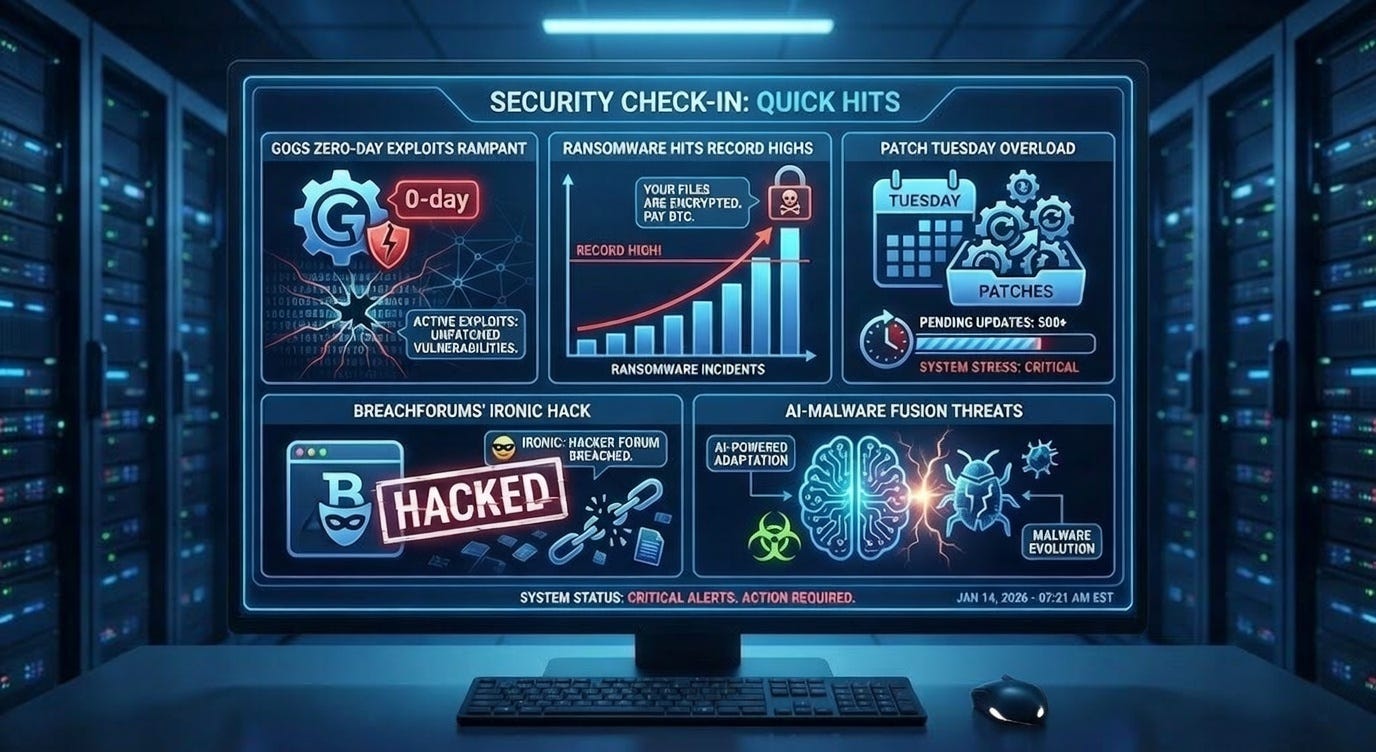
Exploitation of Gogs Vulnerability: A Critical Zero-Day Threat
In the ever-evolving landscape of cybersecurity, vulnerabilities in open-source software continue to pose significant risks. One of the standout issues from the past 24 hours is the active exploitation of a high-severity flaw in Gogs, a self-hosted Git service. Designated as CVE-2025-8110, this remote code execution (RCE) vulnerability allows attackers to execute arbitrary code through path traversal and symbolic link abuse. The U.S. Cybersecurity and Infrastructure Security Agency (CISA) has added it to its Known Exploited Vulnerabilities (KEV) catalog, mandating federal agencies to patch or discontinue use of affected systems immediately.
Reports indicate that over 1,400 servers remain exposed, making them prime targets for data theft or further compromise. This zero-day has been abused in the wild for months, highlighting the dangers of delayed patching in git repositories. Organizations using Gogs should prioritize updates to mitigate risks of unauthorized code execution, file modifications, and potential denial-of-service attacks. The business impact is severe: complete data corruption, exposure of sensitive information, and service disruptions could cripple operations.
This incident underscores a broader trend in supply chain vulnerabilities, where attackers exploit trusted tools to gain footholds. As cyber threats accelerate, proactive vulnerability management isn’t optional—it’s essential. Stay vigilant, scan your environments, and apply patches without delay to avoid becoming the next victim.
Ransomware Attacks: Surging Threats and Global Impact
Ransomware remains a dominant force in the cybersecurity arena, with fresh reports detailing a spike in activity over the last day. A 24-hour snapshot reveals 49 attacks worldwide, predominantly targeting the United States (28 incidents), followed by South Africa, Thailand, the UK, and Taiwan. Key sectors hit include business services (9), healthcare (7), food and beverage (6), manufacturing (5), and industrial machinery (4). Leading groups like Devman (23 attacks), INC (7), Qilin (7), and Akira (6) are driving this surge.
Notable breaches include the University of Hawaii Cancer Center falling victim to ransomware, disrupting critical operations, and Spanish energy giant Endesa disclosing a data breach. Additionally, Russia’s APT28 group has been linked to targeting energy research, amplifying geopolitical cyber risks. In healthcare, threats like ransomware on EHR servers and unpatched VPNs expose flat networks and weak identity controls to exploitation.
These attacks evolve rapidly, with actors using trusted partners as entry points and spearphishing campaigns like BaoLoader for initial access. The rise in victims among professional, scientific, and technical services (PSTS) firms—up 57%—signals a shift toward high-value targets. Global incidents are on the rise, fueled by sophisticated techniques that bypass traditional defenses.
To combat this, organizations must bolster backups, implement multi-factor authentication, and conduct regular simulations. Ransomware isn’t just a technical issue—it’s a business continuity crisis. As threats loom larger, investing in resilience could mean the difference between recovery and ruin.
January Patch Tuesday: A Flood of Vulnerabilities and Urgent Fixes
Patch Tuesday has once again spotlighted the relentless pace of vulnerability disclosures, with Microsoft addressing 113 flaws, including one zero-day (CVE-2026-20805) and eight critical ones. Third-party updates are equally pressing: Google Chrome and Microsoft Edge fix high-severity memory corruption issues enabling remote code execution via malicious web content. Fortinet FortiGate tackles critical authentication bypasses (CVE-2025-59718, CVE-2025-59719) under active exploitation.
Other highlights include Veeam Backup & Replication’s critical auth bypass (CVE-2025-59470, CVSS 9.8), ConnectWise ScreenConnect’s RCE potential (CVE-2025-14265), Ivanti Endpoint Manager’s stored XSS (CVE-2025-10573), and MongoDB’s “MongoBleed” pre-auth memory disclosure (CVE-2025-14847). SAP platforms face multiple critical vulns (up to CVSS 9.9), while Microsoft Visual Studio/Code addresses command injection in AI components (CVE-2025-55319). Apple iOS/macOS/iPadOS patches WebKit exploits, some already in the wild.
This barrage follows December 2025’s 120% surge in critical CVEs (22 total), with React2Shell dominating threats. Additional concerns include Apache NimBLE Bluetooth flaws, Mailpit SSRF/CSWSH, and TinyOS buffer overflow.
For security teams, this means prioritizing automated patching and vulnerability scanning. Delays can lead to breaches, as seen with exploited zero-days. In a three-front war of cybercrime, AI misuse, and supply chains, robust patch management is your first line of defense. Update now to safeguard your infrastructure.
BreachForums Hacked: Irony in the Cybercrime Underworld
In a twist of poetic justice, BreachForums—a notorious hub for cybercriminals—has itself been compromised, exposing data on 324,000 users. This massive leak includes accounts of hackers trading stolen data, underscoring the precarious nature of underground forums.
The breach highlights how even platforms built for illicit activities aren’t immune to attacks. Details emerged amid other high-profile incidents, like the Apex Legends hack where players’ characters were hijacked during live matches. Such events reveal vulnerabilities in gaming and forum ecosystems, often stemming from compromised credentials—the leading cause of major breaches today.
Stolen passwords, tokens, and machine identities create new attack paths, turning trusted access into enterprise risks. This incident aligns with rising global cyber incidents, including telecom espionage and ongoing DDoS attacks in regions like the UK.
For organizations, the lesson is clear: monitor dark web exposures and enforce zero-trust models. Irony aside, this breach could disrupt cybercrime networks but also arm investigators. In the cat-and-mouse game of cybersecurity, no one is truly safe—strengthen your defenses accordingly.
Emerging AI and Malware Threats: From Automation to Cloud Attacks
AI’s rapid integration brings both innovation and peril, with recent reports flagging automation exploits, prompt poaching, and telecom espionage as key threats. AI agents now handle full workflows, boosting productivity but exposing risks like unsecured Machine Control Protocols (MCPs) and shadow API keys, as seen in CVE-2025-6514.
Compounding this is the new VoidLink malware, a Zig-based framework targeting Linux cloud systems in AWS, GCP, Azure, Alibaba, and Tencent. It features advanced evasion and self-deletion, marking a shift in cloud-native attacks. Other malware like GuLoader (via phishing) and emerging threats such as Lumma Stealer add to the mix.
Supply chain issues persist, with n8n attacks stealing OAuth credentials and geopolitical tensions fueling AI misuse. Daily roundups note phishing surpassing ransomware in some metrics, with new malware evolving amid global rises.
To counter, secure AI tools, audit cloud configs, and adopt behavioral detection. As threats weaponize innovation, ethical AI governance and robust monitoring are vital to stay ahead.