


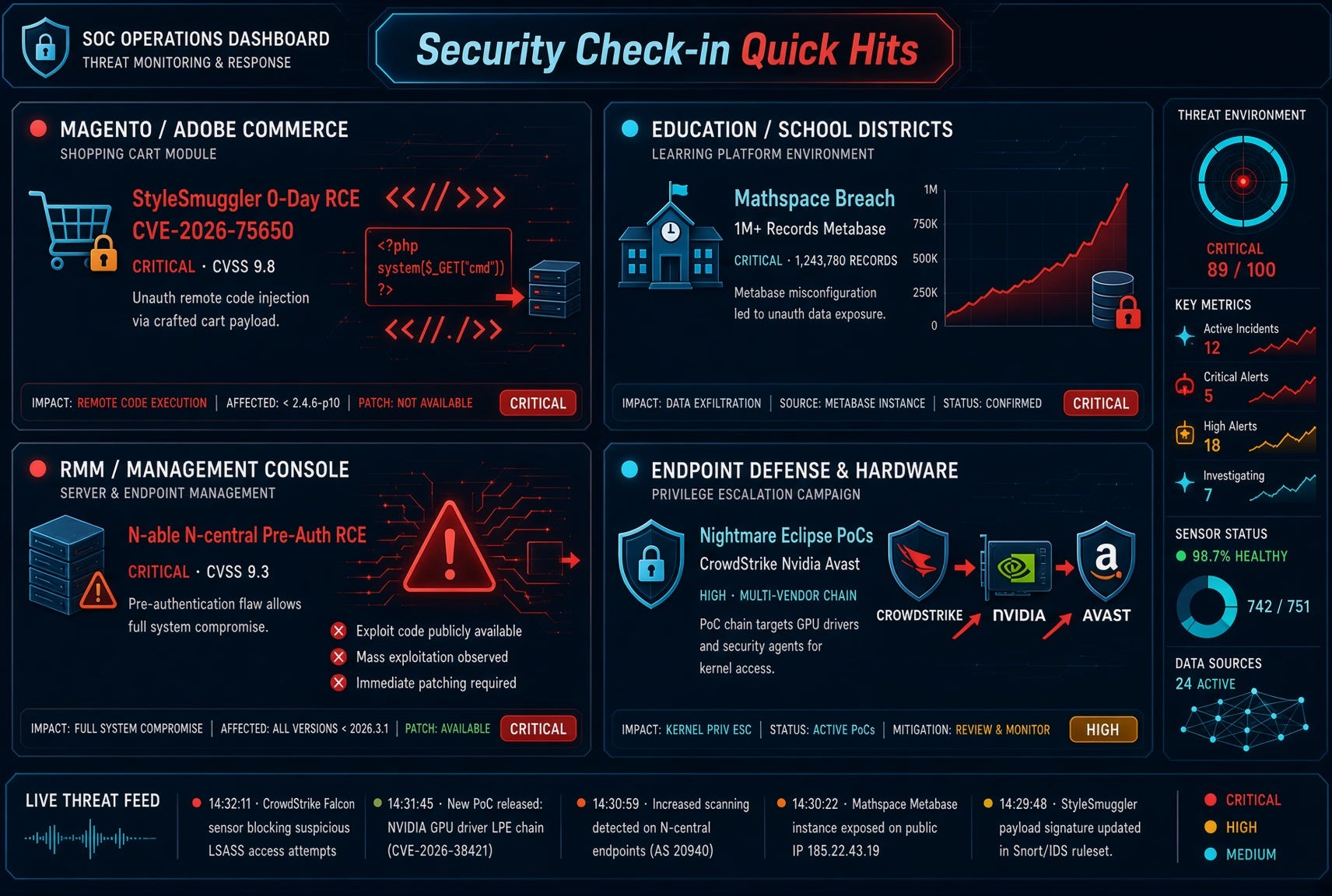
Adobe Patches Actively Exploited Magento/Adobe Commerce Zero-Day “StyleSmuggler”
A critical unauthenticated remote code execution vulnerability in Adobe Commerce and Magento Open Source (CVE-2026-75650, CVSS 10.0), dubbed StyleSmuggler by researchers at Sansec, came under active exploitation starting around September 4. Attackers abused Magento’s template system via PHP code injection tied to failed-payment reminder emails, achieving arbitrary code execution without authentication. Observed payloads included a stealthy Rust-based Linux backdoor (masquerading as processes like kworker or fc-cache, with C2 traffic resembling NTP) and PHP web shells.
Adobe released an emergency hotfix (APSB26-146 / VULN-39341) on September 7, confirming in-the-wild exploitation targeting merchants. Affected versions include Adobe Commerce and Magento Open Source 2.4.4 through 2.4.9 (August 2026 and earlier builds), plus certain B2B releases. Merchants must apply the patch immediately, rotate encryption keys and credentials, and hunt for indicators of compromise (unexpected binaries, web shells, anomalous scheduled tasks, or outbound connections). Interim advice had included disabling GraphQL where feasible. This incident underscores the risk to e-commerce platforms when core template and email features can be chained into RCE.
Mathspace Breach Exposes Data of Over 1 Million Students, Staff, and Parents
Australian online maths learning platform Mathspace disclosed that attackers accessed its self-hosted Metabase internal reporting system and exfiltrated data affecting 1,079,819 people (students, teachers/staff, parents/guardians) in Australia and New Zealand. Unauthorized access began around August 10, with data downloaded on August 27; the company confirmed the incident on September 3 and publicly disclosed around September 6–7.
The entry point was an unpatched critical vulnerability in Metabase (a business-intelligence tool) that allowed unauthenticated administrator access. Metabase had issued a critical advisory and patches on August 6; Mathspace’s internal process did not escalate it promptly, and the instance was updated only on August 29. Exposed fields included user IDs, usernames, names, email addresses, country/timezone, user type, verification status, and activity timestamps. No passwords, academic records, results, or authentication tokens were reported stolen. The compromised system was taken offline. Affected individuals should watch for phishing or social-engineering attempts that leverage the leaked contact details. The case highlights the danger of delayed patching on internal analytics tools that sit atop sensitive databases.
N-able Issues Hotfix for Critical Pre-Auth RCE in N-central (Exploited in the Wild)
N-able released Hotfix 4 for its N-central remote monitoring and management (RMM) platform (build 2026.3.1.14) to address CVE-2026-86218, a maximum-severity pre-authentication remote code execution flaw (CVSS 10.0, static code injection). The vulnerability affects on-premises N-central deployments prior to this build and can allow unauthenticated attackers to execute code on the server.
N-able and researchers (including Huntress) indicated the issue has been observed in the wild; earlier related high-severity authentication-bypass flaws had also seen activity. Hosted instances were addressed server-side. On-premises administrators are urged to upgrade immediately, review logs for scanning from noted IP ranges (e.g., 23.234.64.0/18), and check for unexpected newly created user accounts. This continues a recent pattern of urgent N-central fixes and reinforces why RMM platforms—often highly privileged and internet-facing for MSPs—remain high-value targets.
Researcher “Nightmare Eclipse” Drops Privilege-Escalation PoCs Targeting CrowdStrike, Nvidia, and Avast
Security researcher Nightmare Eclipse published proof-of-concept exploits for local privilege-escalation issues in several security and graphics products: FalconFlank (CrowdStrike Falcon Sensor, abusing Office malicious-macro remediation to reach SYSTEM), PrettyPrague (Avast sandbox, potentially affecting other Gen Digital products, enabling SYSTEM shell and SAM dump), and GreenSection (Nvidia shared global memory section out-of-bounds write, useful for cross-user or process compromise).
CrowdStrike advised customers to disable the relevant Microsoft Office File Suspicious Macro Removal policy setting while investigating and noted continued protection via other cloud anti-malware features. These drops add to the researcher’s recent series of high-profile local privilege-escalation disclosures. Organizations running the affected products should monitor vendor advisories, apply any available mitigations or detections, and treat endpoint security software itself as part of the attack surface.
Honorable mentions from the same window: Exposure of ~220 million traveler/crew records (names, passport details, flight info spanning 2017–2026) in a Vietnam-linked Advance Passenger Information System database left accessible via misconfiguration; ongoing discussion of BigBear 2.0 phishing-as-a-service campaigns targeting Microsoft 365 credentials (including MFA bypass at scale); and reports of North Korean actors deploying a new Linux espionage toolkit.
Stay patched, monitor privileged management platforms and e-commerce stacks closely, and assume internal BI/analytics tools can become high-impact entry points if left unpatched.