


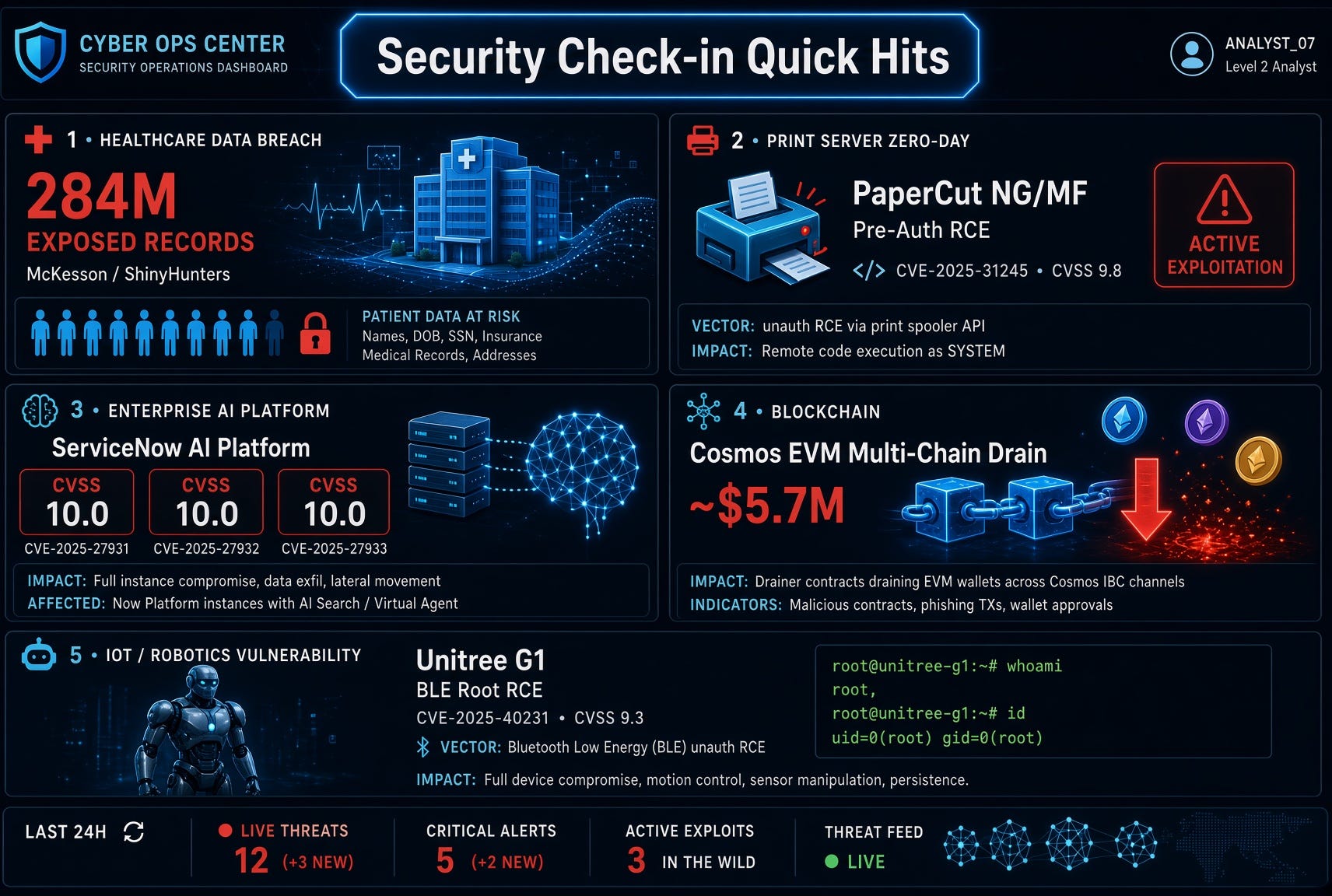
McKesson Confirms Incident as ShinyHunters Claims 284 Million Patient Records
Healthcare and pharmaceutical distribution giant McKesson disclosed a cybersecurity incident involving unauthorized access to third-party applications after the ShinyHunters extortion group claimed it stole roughly 284 million patient-related data records.
McKesson said it discovered the activity on August 25, 2026; its investigation remains early-stage. ShinyHunters alleged entry via voice-phishing (vishing) of employees that compromised Okta SSO access, followed by data extraction from Salesforce and Snowflake environments over several days (approximately 1 TB claimed). The purported haul includes names, addresses, dates of birth, Social Security numbers, patient IDs, medical record numbers, Medicaid numbers, medication/allergy details, appointment data, and physician information, plus some employee and provider records. The group demanded more than $55 million and has not reported a response from the company.
This continues ShinyHunters’ pattern of large-scale healthcare and SaaS data-theft campaigns that rely on social engineering against identity providers. Organizations should treat third-party SaaS and data-warehouse access as high-value targets and enforce stronger phishing-resistant MFA and monitoring of anomalous API/data-export activity.
PaperCut NG/MF Under Active Pre-Auth RCE Exploitation; Second Emergency Patch Issued
PaperCut Software warned that two vulnerabilities in its widely used PaperCut NG and MF print-management products are being actively exploited in the wild, enabling unauthenticated remote code execution.
The flaws (CVE-2026-81578 authentication bypass and CVE-2026-82078 unsafe dynamic class loading) can be chained so that an attacker reaching the web management interface gains control of trusted configuration and executes arbitrary Java code inside the application server process (often as SYSTEM). Huntress and others observed real-world exploitation, including short reconnaissance commands and malicious Java payloads designed to profile systems and cover tracks. PaperCut released an initial emergency patch, then a hardened “Release 2” after researchers found bypasses of the first fix. Patches cover versions 24–26; older versions should be upgraded.
Immediate actions: restrict the management interface to trusted IPs or take it offline from the public internet, apply the latest emergency builds, and hunt for indicators of compromise around the PaperCut application server process. Print-management systems remain attractive because they often sit at the intersection of user devices and internal networks.
ServiceNow Patches Three Maximum-Severity AI Platform Flaws
ServiceNow released fixes for three CVSS 10.0 vulnerabilities in its AI Platform (plus a high-severity sandbox-escape issue) that, under certain conditions, allow unauthenticated attackers to execute code, perform SQL injection, create or modify instance data, or escalate privileges.
CVE-2026-18885 (code injection via GraphQL Composite Data API), CVE-2026-18886 (improper access control in an image-upload processor), and CVE-2026-74820 (SQL injection via dynamic schema ORDER BY) require no credentials or user interaction in the worst case. A fourth issue (CVE-2026-6876) enables sandbox escape and RCE with low privileges. ServiceNow stated it is not aware of active exploitation and has patched hosted instances; self-hosted customers must apply the relevant hotfixes for Xanadu, Yokohama, Zurich, and Australia families.
Because ServiceNow instances frequently hold sensitive operational data and increasingly power AI agent workflows, these flaws expand the potential blast radius. Prioritize patching self-hosted environments and review any exposed AI-related endpoints or GraphQL surfaces.
Cosmos EVM Balance Flaw Exploited Across Six Chains After Months of Knowledge
Cosmos Labs published a post-mortem confirming that a critical balance-handling vulnerability in the shared Cosmos EVM module was exploited between August 20 and 25, 2026, draining funds from six blockchains.
Attackers combined accounting inconsistencies between Cosmos EVM and the Cosmos SDK (including an unsigned-integer underflow involving vesting accounts) to extract legitimate tokens without inflating total supply. Total impact was estimated at roughly $5.7 million ($2.87M sold on DEXes and ~$2.85M routed through CEXes, with some accounts frozen). The issue had been reported via bug bounty months earlier and was assessed at the time as lower risk; patches shipped in v0.6.2 / v0.7.2, but many chains had not fully applied them before exploitation.
Shared-module designs create correlated risk: one flaw can hit multiple independent networks. Chains still running vulnerable versions should halt if necessary, upgrade immediately, and review vesting-account and precompile handling.
Unitree G1 Humanoid Robots Vulnerable to Root RCE via Bluetooth
Security research disclosed two independent root remote-code-execution chains against the Unitree G1 EDU humanoid robot, one of which begins with unauthenticated Bluetooth Low Energy interaction.
Tracked as CVE-2026-76639 and CVE-2026-76640, the more dramatic path (UniBLEed) abuses a BLE characteristic that accepts writes without pairing, recovers key material via a cloud endpoint that previously lacked ownership checks, hijacks Wi-Fi provisioning through command injection, leaks process information via a chatbot knowledge-base path traversal, and finally triggers a buffer overflow in the Bluetooth GATT server that yields root on the locomotion PC (the system controlling movement, cameras, speakers, and related hardware). Unitree had patched the cloud ownership check earlier; confirmed fixed firmware for the full chains was not publicly detailed at disclosure.
Physical-proximity attacks on increasingly capable robots raise novel risks for labs, warehouses, and public demonstrations. Owners should isolate robots from untrusted BLE/Wi-Fi environments, apply any available firmware updates, and treat cloud-to-device binding as a high-privilege operation.
These incidents illustrate recurring themes: social-engineering entry into large SaaS environments, unauthenticated RCE in widely deployed enterprise software, AI-platform attack surfaces, shared blockchain infrastructure risk, and the expanding attack surface of physical autonomous systems. Patch aggressively, reduce public exposure of management interfaces, and treat identity and third-party access as primary control points.