


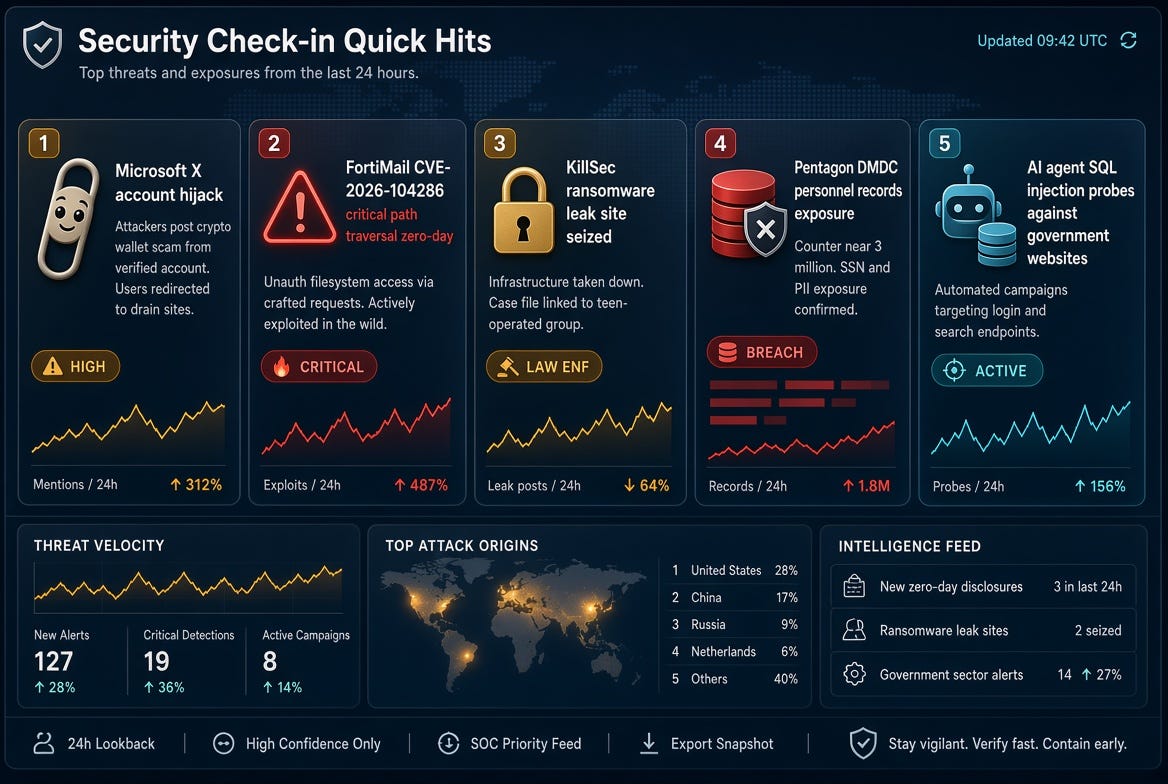
Microsoft’s X account was used to pump a Clippy token
On Thursday, attackers took over Microsoft’s official X account (@Microsoft, more than 13 million followers) for roughly half an hour and used it as the megaphone for a crypto pump-and-dump. The account followed and reposted a now-suspended account impersonating Clippy (@clippymsftcto), swapped in a Clippy-themed profile image, and pushed a token styled as $Clippy with a claimed liquidity pool paired to $MSFT. A second account, @ClippyMSFT, kept promoting the token after the original was suspended.
Microsoft spokesperson Brent Colburn confirmed unauthorized access and posts that did not come from the company. The account has been secured, the posts removed, and the investigation is ongoing. A now-deleted company note said Microsoft does not support any cryptocurrency or token, has not authorized use of Clippy, Microsoft, or $MSFT branding, and would pursue legal action.
The operational lesson is not exotic malware. High-follower brand accounts remain a cheap distribution channel for scams, and nostalgia (Clippy, “like this for an official return”) is enough social engineering to move a market for minutes. Treat official social posts that promote tokens, wallet addresses, or “limited liquidity” as hostile until the company confirms them on a second channel. For organizations that run verified accounts, hardware-backed admin, short session lifetimes, and alerting on profile or follow changes matter more than another awareness poster.
FortiMail path traversal is in the wild and on the KEV
CISA added CVE-2026-104286 to the Known Exploited Vulnerabilities catalog on October 1. Fortinet describes it as a critical path traversal in FortiMail (CVSS 9.8 in public reporting) that lets an unauthenticated attacker write arbitrary files and run unauthorized code or commands on exposed email security gateways. Fortinet says the flaw was exploited as a zero-day and has published a workaround until patches are applied.
Email gateways sit on the path of every message and often have broad internal trust. A file-write bug there is not a noisy ransomware event. It is a quiet foothold in front of the mail flow. Federal civilian agencies are expected to prioritize this class of KEV on internet-exposed systems that yield full control after exploitation, and CISA is pointing everyone else at the same order of operations: patch or apply the vendor workaround, then check whether the box was already compromised.
Hunt for unexpected files written under FortiMail paths, new admin sessions, and outbound connections that do not match normal mail or update traffic. If the appliance cannot be patched this week, take it off the internet or put the workaround in front of it. Waiting for a “clean” maintenance window is how zero-days become incidents.
Operation KillSwitch takes down KillSec and a 16-year-old alleged operator
Europol and partners shut down the KillSec leak site on September 30 and secured at least 110 terabytes of stolen victim data so it could not be republished. Operation KillSwitch, led by Hamburg police and prosecutors, covers about 1,000 suspected attacks worldwide, of which roughly 500 are assessed as successful. The leak site had listed on the order of 450 victims before the seizure.
Three people were provisionally arrested and eight properties searched in Spain, Greece, Romania, and the United Kingdom. Investigators identify a 16-year-old Romanian national detained in Alicante as the suspected administrator and main operator. A suspected developer turned 18 in August 2026 and was a minor for some of the alleged offenses. A Dutch national living in the UK, Fouad Eltibrizi (handle Archduke), has been indicted in Puerto Rico on conspiracy, computer-damage, and extortion-threat charges and is held pending extradition. Authorities are tracing crypto proceeds.
KillSec’s model was familiar: exploit weak access, steal data, threaten publication. The age of the alleged core operators is the part that should change staffing assumptions. Ransomware affiliates are not only career crews. Incident response still starts with exposed remote access, unpatched edge devices, and backup isolation, not with guessing who is on the other end of the negotiation portal.
Pentagon personnel records: nearly 3 million people notified
The Defense Manpower Data Center is notifying current and former military personnel after a months-long breach of its human-resources system. Public reporting this week puts the exposure at about 2.76 to 3.1 million people, including Social Security numbers. The intrusion itself dates to October 2025. What is new is the notification wave and the renewed attention on X and in national outlets.
This is a delayed-disclosure problem as much as a technical one. SSNs and service records are durable fraud fuel: tax refunds, benefits, and targeted social engineering against service members and families long after the gateway is closed. Anyone in the notified population should freeze credit, watch IRS and VA accounts, and treat unexpected “DMDC” or benefits calls as hostile until verified out of band. For other large HR systems, the control that would have mattered is not another dashboard. It is short retention of full identifiers, separated admin paths, and detection on bulk export.
AI agents fired SQL injection at U.S. and Canadian government sites
SecurityWeek reported that AI agents directed SQL injection at the U.S. Department of Education and Library and Archives Canada, with researchers linking some of the agents to OpenAI. The same 24-hour window includes Microsoft’s Digital Defense line that attackers are currently getting more speed out of AI than defenders: faster vulnerability discovery, malware development, and post-compromise work. Adjacent reporting describes TA419, a China-aligned group, impersonating a former White House official and an Anthropic-linked figure to phish AI policy experts, and a separate Zammad zero-day chain used in an AI-assisted intrusion against the Dutch Institute for Vulnerability Disclosure.
The pattern is not “AI replaces attackers.” It is agents and assisted workflows compressing the time between a public endpoint and an exploit attempt, including against government sites that still have classic injection bugs. Input validation, least-privilege database accounts, and WAF rules for obvious injection still stop this class of probe. What changes is the volume and the lack of a human pause between recon and payload. Log and rate-limit automated clients, and do not assume a government hostname is uninteresting to an agent doing “research.”
What to do before the weekend: confirm the Microsoft social incident is closed on your brand-monitoring list, patch or workaround FortiMail CVE-2026-104286 if you run it, and if you are in the DMDC notice population, freeze credit today. KillSec’s leak site is in law-enforcement hands. That does not restore the data already stolen.