


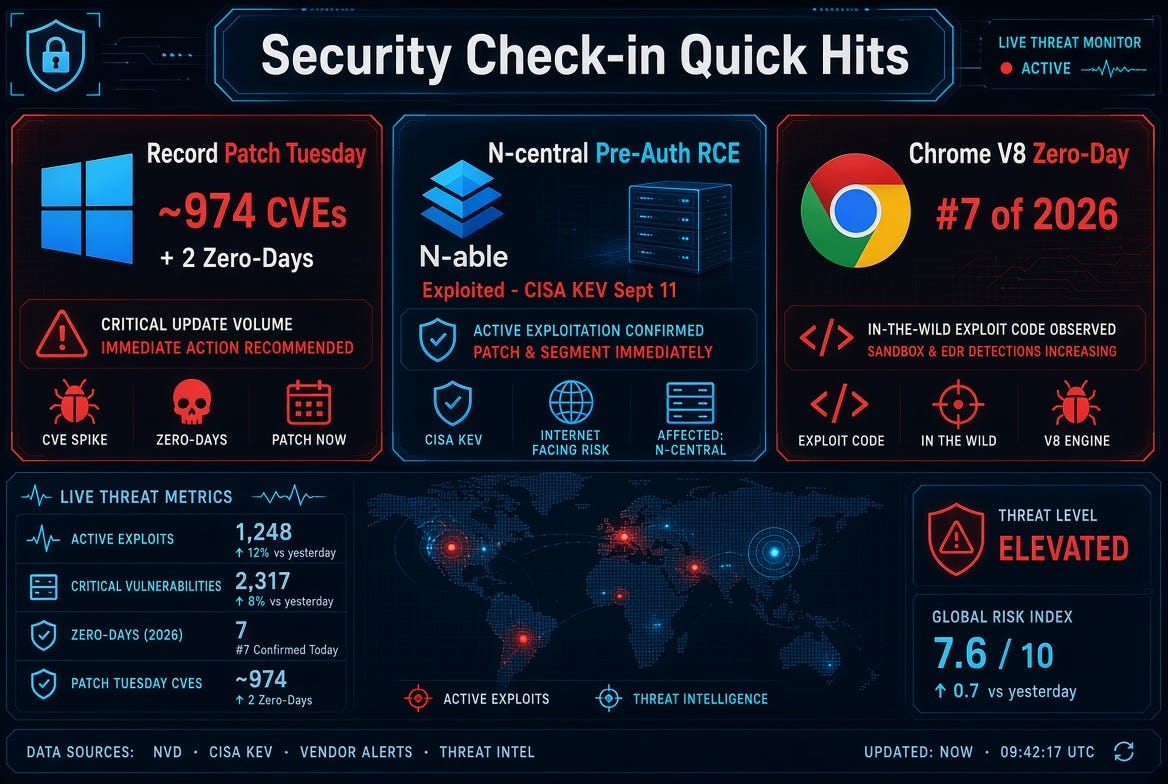
Microsoft Drops Record-Breaking Patch Tuesday with Nearly 1,000 Fixes and Two Actively Exploited Zero-Days
Microsoft’s September 2026 Patch Tuesday is the largest on record, addressing approximately 974 vulnerabilities (with customer-actionable counts reported around 964–966 after excluding some cloud-side fixes). This obliterates prior monthly highs and continues the trend of AI-assisted vulnerability discovery driving higher volumes.
Two of the fixes cover actively exploited zero-days, both local privilege-escalation bugs rated around CVSS 7.8:
CVE-2026-81963 in the Windows Update Stack (improper link resolution/access control), allowing low-privilege attackers to reach SYSTEM.
CVE-2026-85880, a heap-based buffer overflow in Windows Advanced Local Procedure Call (ALPC).
The release also includes a high number of critical issues (over 100 in some counts), among them potentially wormable remote code execution flaws in components such as Windows DNS Server and Remote Desktop-related services, plus fixes spanning Office, Exchange, SharePoint, SQL Server, and core Windows components.
Why it matters: The sheer volume creates operational pressure for IT teams, while the two zero-days mean unpatched systems are already under active attack. Organizations should prioritize the zero-days and critical RCEs first, then systematically roll out the rest. Testing remains essential given the size of the update package. End users and admins: install the latest cumulative updates promptly and verify deployment.
This month’s total also pushes Microsoft’s 2026 CVE count well past previous annual records, underscoring how discovery tools are changing the patching landscape.
N-able N-central Pre-Auth RCE Zero-Day Under Active Exploitation — CISA Deadline September 11
N-able’s N-central remote monitoring and management (RMM) platform, widely used by managed service providers (MSPs) to administer client endpoints, is facing a critical pre-authentication remote code execution vulnerability tracked as CVE-2026-86218 (CVSS 10.0). The flaw involves static code injection that can allow unauthenticated attackers to execute code on the N-central server.
CISA added it to the Known Exploited Vulnerabilities (KEV) catalog, giving Federal Civilian Executive Branch agencies until September 11, 2026, to apply fixes. N-able released Hotfix 4 (bringing on-premises builds to 2026.3.1.14) after earlier hotfixes for related issues. Hosted instances received server-side protections; on-premises deployments require immediate manual application.
Exploitation has been observed (or strongly indicated) in the wild, with scanning activity noted from specific IP ranges. A compromised N-central server gives attackers a high-privilege push channel into every managed endpoint—making this especially dangerous for MSPs and their customers. Administrators are urged to check for unexpected new user accounts and review logs for anomalous connections.
Why it matters: RMM tools sit at the center of IT operations. One successful exploit can cascade across an entire client base. This is the latest in a series of recent N-central issues, highlighting the need for rapid patching of management platforms and network segmentation. If you run N-central, apply the hotfix now, audit for compromise indicators, and monitor for further guidance from N-able and CISA.
Google Patches Seventh Chrome Zero-Day of 2026 — V8 Out-of-Bounds Write Already Exploited
Google released Chrome 153 (versions 153.0.8010.36/.37 depending on platform) containing fixes for 230 security vulnerabilities, including an actively exploited zero-day in the V8 JavaScript and WebAssembly engine. Tracked as CVE-2026-87491, the medium-severity out-of-bounds write allows a remote attacker to execute arbitrary code inside the sandbox via a crafted HTML page.
Google explicitly stated it is aware of in-the-wild exploits. This is the seventh actively exploited Chrome zero-day patched in 2026, following a rapid cadence that has included multiple V8 issues. The flaw was reported by a researcher at Seoul National University’s Compsec Lab.
Why it matters: Chrome (and Chromium-based browsers) remains a primary attack surface for drive-by and targeted exploits. With confirmed exploitation, delaying the update leaves users exposed to code execution within the browser sandbox—often a stepping stone to further compromise. Users should update immediately via Settings → About Chrome (or equivalent) and relaunch. Enterprises should accelerate browser update policies and consider additional mitigations such as site isolation and restricted JavaScript where feasible.
These three stories—massive Windows patching pressure, a critical MSP tool under active attack, and yet another Chrome engine zero-day—illustrate the relentless pace of both defensive updates and offensive exploitation in mid-September 2026. Prioritize the zero-days and high-impact management platforms first.