


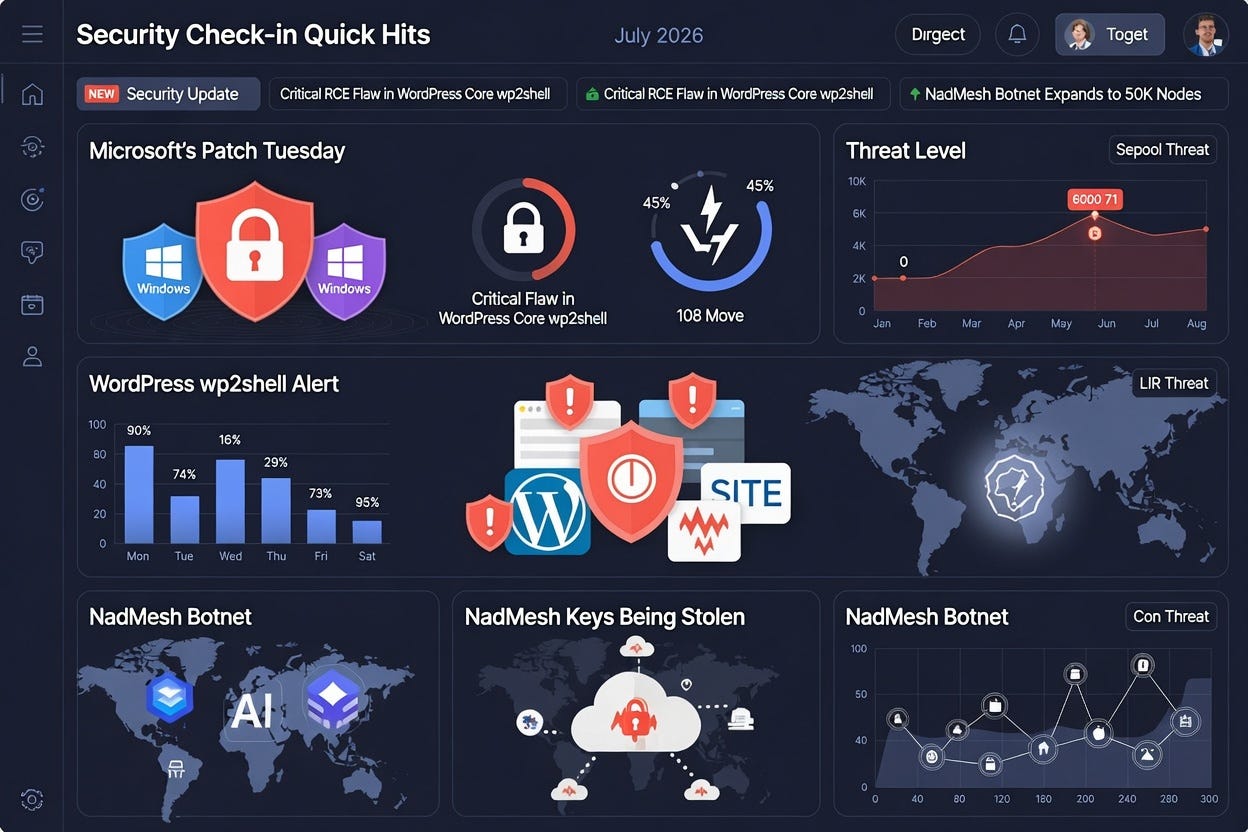
Microsoft’s July 2026 Patch Tuesday: Record-Breaking 600+ Vulnerabilities Fixed
Microsoft released one of its largest security update batches ever in July 2026, addressing over 600 vulnerabilities (reports vary from ~569 to 627 CVEs) across Windows, Office, SharePoint, Azure, and related products. This included multiple critical remote code execution flaws, with at least two or three zero-days that were actively exploited in the wild prior to patching.
Key Takeaways:
Prioritize immediate patching, especially for enterprise environments.
This release highlights the growing complexity of modern software and the role of AI in both discovery and defense.
Admins should test updates carefully, noting temporary holds on certain Dell devices due to compatibility issues.
Organizations running Microsoft ecosystems should scan for exposure and apply updates ASAP to avoid exploitation of the zero-days.
wp2shell WordPress Core Flaw (CVE-2026-63030 + CVE-2026-60137): Pre-Auth RCE Hits Millions of Sites
A critical pair of vulnerabilities dubbed wp2shell was disclosed and patched in mid-July 2026, affecting WordPress versions 6.9.0–6.9.4 and 7.0.0–7.0.1. The chain combines REST API batch-route confusion with SQL injection, allowing unauthenticated attackers to achieve remote code execution on default installs—no plugins required.
WordPress.org pushed emergency updates (6.9.5 and 7.0.2) with forced auto-updates. Public proofs-of-concept emerged quickly, making prompt patching essential. Sites on vulnerable versions face full compromise risks, including data theft or malware deployment.
Action Items: Update immediately, restrict anonymous access to /batch/v1 endpoints if delayed, and audit plugins/themes. This underscores the massive attack surface of WordPress, which powers a huge portion of the web.
NadMesh Botnet Targets Exposed AI Services for Cloud Credentials
A new Go-based botnet called NadMesh emerged in early July 2026, aggressively scanning for exposed AI/ML and workflow tools like ComfyUI, Ollama, n8n, Open WebUI, Langflow, and Gradio. It exploits over 20 RCE vectors (including Docker, Kubernetes, Redis) to harvest AWS keys, Kubernetes tokens, model access, and other credentials.
Operators use Shodan for targeted harvesting, prioritizing fresh AI deployments. The botnet features robust persistence and has reportedly stolen thousands of AWS keys. This reflects the rush to deploy AI infrastructure without adequate hardening, creating prime targets for credential theft and further cloud compromise.
Recommendations:
Never expose AI services directly to the internet without strong auth and network controls.
Monitor for unusual scans on common AI ports.
Rotate credentials and review cloud access logs.
These quick hits show ongoing trends: massive patch volumes, core software risks in popular platforms, and attackers pivoting to AI/cloud environments. Stay vigilant, patch ruthlessly, and secure your exposures.