

Security Check-in Quick Hits: Notepad++ Supply Chain Attack, Microsoft Office Zero-Day Exploitation, Panera Bread Data Breach, Ivanti EPMM Vulnerabilities, Kimwolf Botnet Infections
For February 4, 2026

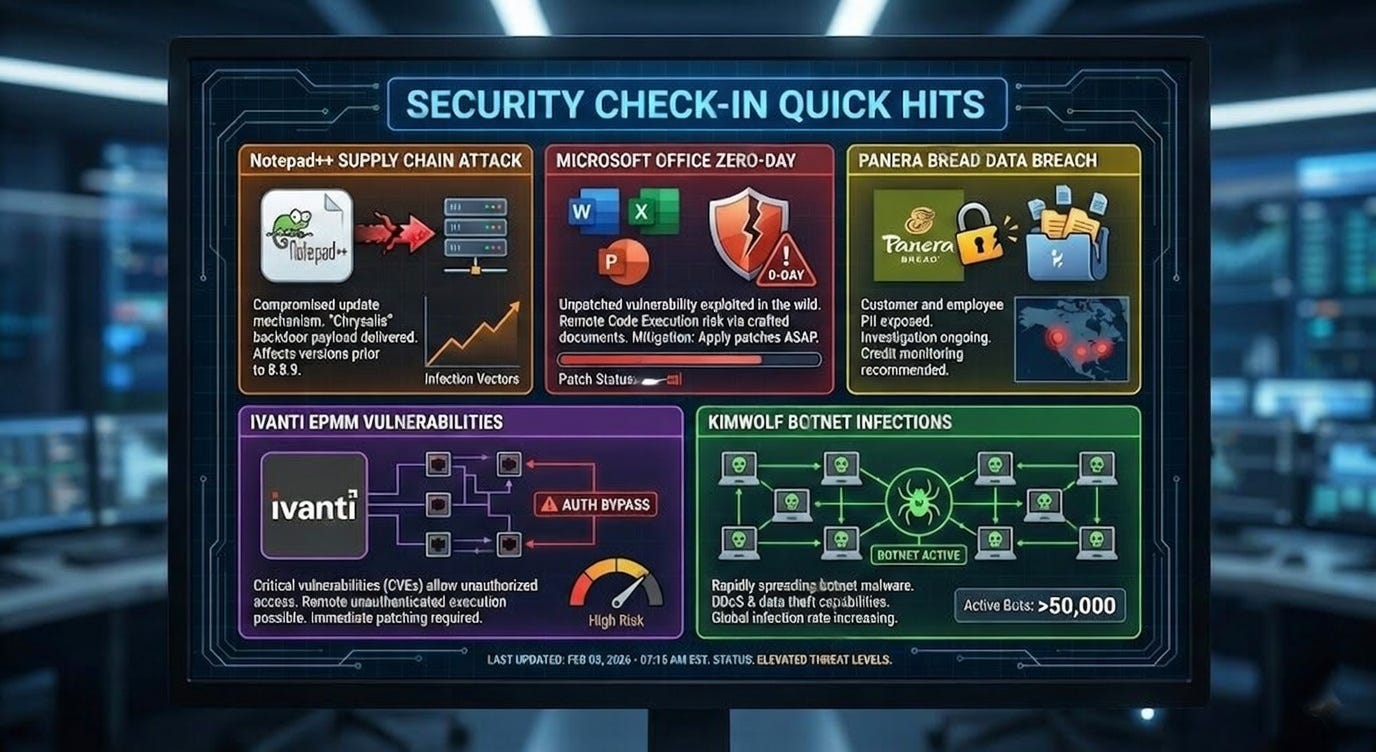
Notepad++ Supply Chain Attack: A Wake-Up Call for Open-Source Security
In the ever-evolving landscape of cybersecurity threats, supply chain attacks continue to pose significant risks to users and organizations alike. The recent compromise of Notepad++, a popular open-source text editor, exemplifies how attackers can infiltrate trusted software distribution channels to target specific victims.
The attack, which spanned from June to December 2025, involved compromising the shared hosting provider for notepad-plus-plus.org. Attackers intercepted update requests via the built-in updater (GUP.exe), selectively redirecting victims in sectors like telecom, finance, and East Asian organizations to malicious servers hosting trojanized executables. This selective targeting suggests involvement of a Chinese state-sponsored group, focusing on espionage rather than widespread infection. The incident was discovered in December 2025 by security researcher Kevin Beaumont, leading to hardened releases: version 8.8.8 restricted to GitHub downloads and 8.8.9 with enhanced signature validation.
The impacts are profound, enabling long-term persistence and data exfiltration in high-value targets. Unlike mass breaches, this attack’s precision minimized detection, potentially affecting thousands of users who relied on automatic updates.
To mitigate such risks, users should verify update signatures, opt for direct downloads from official repositories like GitHub, and scrutinize third-party infrastructure. Organizations are advised to implement end-to-end supply chain verification and behavioral monitoring.
This incident underscores the vulnerabilities in open-source ecosystems. As reliance on such tools grows, bolstering security measures is crucial to prevent future compromises.
Microsoft Office Zero-Day Exploitation by APT28: Escalating Cyber Espionage
Cyber espionage remains a persistent threat, with state actors exploiting software vulnerabilities to gain unauthorized access. The recent zero-day in Microsoft Office, CVE-2026-21509, has been weaponized by Russia’s APT28 group in targeted attacks.
Patched on January 26, 2026, this high-severity flaw (CVSS 7.8) bypasses Object Linking and Embedding (OLE) mitigations, allowing arbitrary code execution via malicious documents. APT28, also known as Fancy Bear, began exploiting it just three days after disclosure, targeting entities in Ukraine, Slovakia, and Romania through phishing emails with booby-trapped Word documents. The campaign, dubbed Operation Neusploit, deploys malware like MiniDoor and Covenant Grunt for post-exploitation, focusing on credential theft and persistence. CISA added the vulnerability to its Known Exploited Vulnerabilities catalog, mandating federal agencies to patch by mid-February 2026.
Impacts include potential data theft, unauthorized code execution, and compromised enterprise environments, exacerbating geopolitical tensions in affected regions.
Recommendations include immediate patching, enabling Protected View for untrusted documents, and deploying endpoint detection tools. Integrating zero-trust principles in document workflows is essential.
This exploitation highlights the speed at which state actors adapt, emphasizing the need for rapid response and robust defenses against sophisticated threats.
Panera Bread Data Breach: Lessons in Extortion and Data Protection
Data breaches continue to plague major corporations, exposing millions to identity theft risks. The recent Panera Bread incident, claimed by ShinyHunters, illustrates the dangers of vulnerabilities in authentication systems.
In January 2026, hackers compromised a Microsoft Entra single-sign-on (SSO) code, stealing records of approximately 14 million accounts. After a failed extortion attempt, they leaked data including 5.1 million unique email addresses, names, phone numbers, and physical addresses, plus PII of over 26,000 employees. The breach exploited weak authentication mechanisms and an insecure API endpoint, allowing mass data extraction via automated scripts. Panera confirmed the incident, notifying authorities and describing the data as “contact information.”
The fallout includes heightened risks of phishing, identity fraud, and voice phishing scams for affected individuals, alongside potential regulatory fines for the company.
To prevent similar breaches, implement strong multi-factor authentication, regular vulnerability scans, and secure API endpoints. Affected users should monitor accounts, change passwords, and enable fraud alerts.
This breach serves as a reminder that even routine customer data can be weaponized, urging businesses to prioritize comprehensive security strategies.
Ivanti EPMM Zero-Day Vulnerabilities: Urgent Patching Imperative
Endpoint management solutions are prime targets for attackers seeking broad access. The discovery of zero-days in Ivanti Endpoint Manager Mobile (EPMM) underscores the criticality of timely updates.
Disclosed in late January 2026, CVE-2026-1281 and CVE-2026-1340 are critical code injection flaws (CVSS 9.8) enabling unauthenticated remote code execution. Exploited in the wild before disclosure, they allow access to PII such as names, emails, phone numbers, GPS data, and device details on managed endpoints. CISA added CVE-2026-1281 to its catalog, requiring federal remediation by February 1, 2026. Proof-of-concept exploits surfaced on January 30, increasing exploitation risks.
Impacts involve severe privacy violations and potential lateral movement in networks, affecting thousands of organizations using Ivanti for mobile device management.
Recommendations: Apply provisional patches immediately, conduct scans, and monitor for anomalies. Enforce least-privilege access and network segmentation.
These vulnerabilities highlight the ongoing arms race in endpoint security, stressing proactive patching and layered defenses.
Kimwolf Botnet Infections: The Rise of Massive DDoS Threats
Botnets represent a formidable force in disrupting digital infrastructure. The Kimwolf botnet, an Android variant of Aisuru, has infected over two million devices, signaling a surge in supply chain-based threats.
Since August 2025, Kimwolf has targeted smart TVs and streaming boxes via pre-consumer supply chain malware, enabling DDoS attacks peaking at 29.7 Tbps. A notable campaign on December 19, 2025, dubbed “The Night Before Christmas,” hit telecom firms with over 200 million HTTP requests per second. Google disrupted related networks like IPIDEA, reducing its scale by seizing domains.
Impacts include crippling global services, setting new DDoS records, and facilitating other crimes like credential stuffing and ad fraud.
Mitigation strategies: Regular patching, automated traffic scrubbing, and zero-trust models. Avoid bandwidth-sharing scams and monitor network activity.
This botnet’s growth warns of escalating volumetric attacks, necessitating advanced defenses for resilient infrastructure.