

Security Check-in Quick Hits: Patch Chaos, Massive Fines, and Persistent Threats
For June 11, 2026

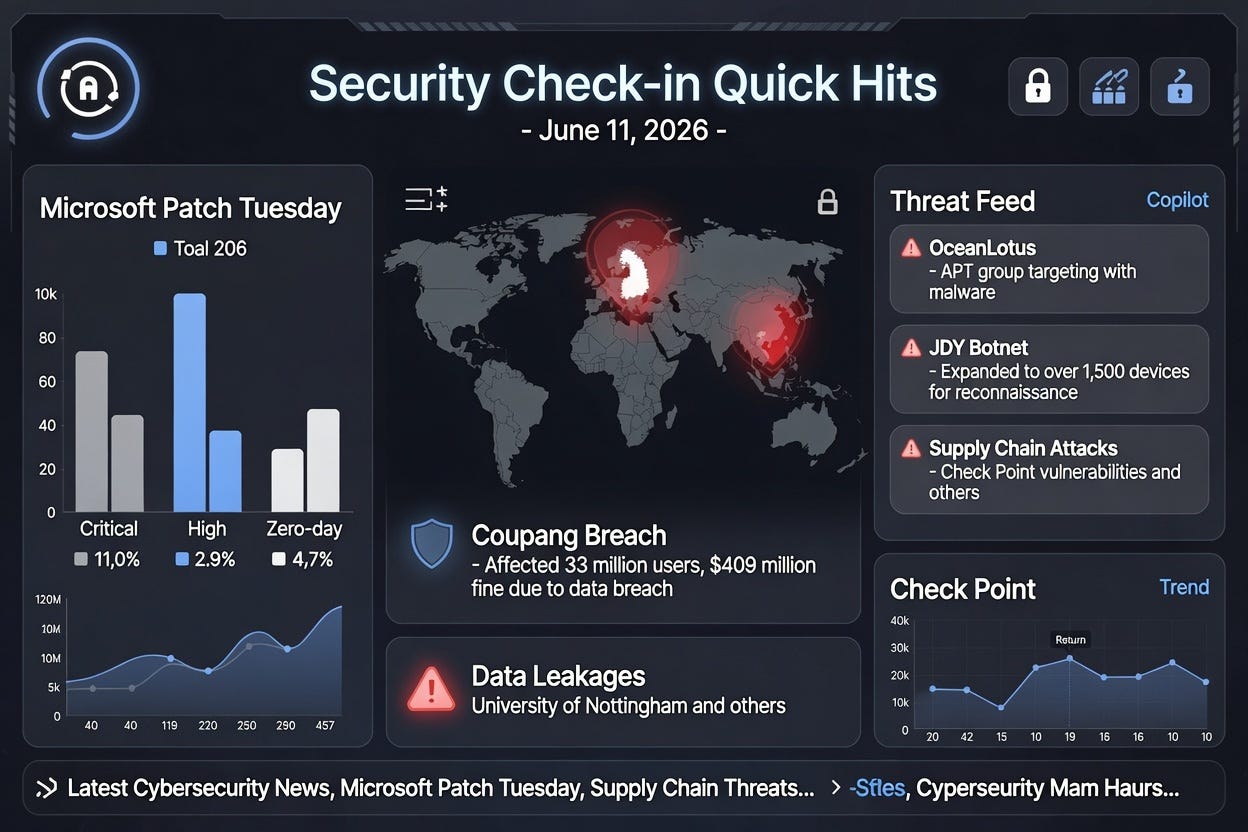
Microsoft’s Record-Breaking Patch Tuesday: 206 Vulnerabilities Fixed, Multiple Zero-Days
Microsoft released its June 2026 Patch Tuesday updates, addressing a record 206 vulnerabilities across Windows, Office, Azure, and related products. This includes several zero-days and critical flaws, with at least three publicly disclosed and actively exploited issues (such as privilege escalation, BitLocker bypasses, and DoS vectors). Additional researcher-discovered issues like “RoguePlanet” (a Defender race condition granting SYSTEM privileges) highlight ongoing challenges in endpoint security.
Key Takeaways for Organizations:
Prioritize immediate patching, especially for internet-facing systems and Exchange Server.
Test updates in staged environments due to the volume.
This underscores the growing complexity of modern software and the need for robust vulnerability management and zero-trust architectures.
Organizations should treat this as a wake-up call: delayed patching remains a top vector for breaches.
South Korea Hits Coupang with Record $409 Million Fine Over Massive Data Breach
South Korea’s privacy regulator imposed the country’s largest-ever data breach penalty—625 billion won (~$409 million)—on e-commerce giant Coupang. The 2025 incident exposed personal data from over 33 million user accounts (affecting a huge portion of the population) due to poor internal controls, including a former employee exploiting authentication flaws and unrevoked cryptographic keys. Issues included delayed reporting, unauthorized tracking, and management failures rather than a sophisticated external hack.
Implications:
Highlights insider threats, credential/key management failures, and the high cost of inadequate monitoring.
Coupang faces boycotts, lawsuits, compensation programs, and appeals while strengthening defenses.
Serves as a global reminder for companies to invest in data governance, access controls, and timely breach disclosure.
Supply Chain and APT Activity: OceanLotus, JDY Botnet, npm Changes, and More
OceanLotus (APT32) targeted Vietnam investors with SPECTRALVIPER malware in supply chain attacks.
JDY Botnet expanded to over 1,500 devices for reconnaissance.
GitHub announced default disabling of npm install scripts to curb supply chain attacks.
Patches rolled out for critical flaws in Ivanti, Fortinet, SAP, Check Point VPN (CVE-2026-50751, exploited by ransomware), and others. CISA added known exploited vulnerabilities to its catalog.
Action Items: Audit third-party dependencies, monitor for anomalous botnet behavior, apply vendor patches urgently, and enhance supply chain security practices.
Additional Notable Incidents
University of Nottingham confirmed a breach with data leaked by ShinyHunters.
Ongoing concerns around infostealers, AI-influenced operations, and zero-days like GreatXML bypassing BitLocker.
Overall Trends: Patching fatigue, credential/infrastructure weaknesses, state-linked espionage, and regulatory enforcement are dominating. Organizations should focus on rapid response, least-privilege access, and continuous monitoring.
Stay Secure: Patch promptly, review access controls, train staff, and monitor threat intelligence sources like CISA and vendor advisories.