

Security Check-in Quick Hits: Patch Tuesday Zero-Days, $4.5B Ransomware Surge, North Korea’s EtherRAT, Pro-Russia OT Attacks, and the Identity Hijacking Epidemic
For December 11, 2025

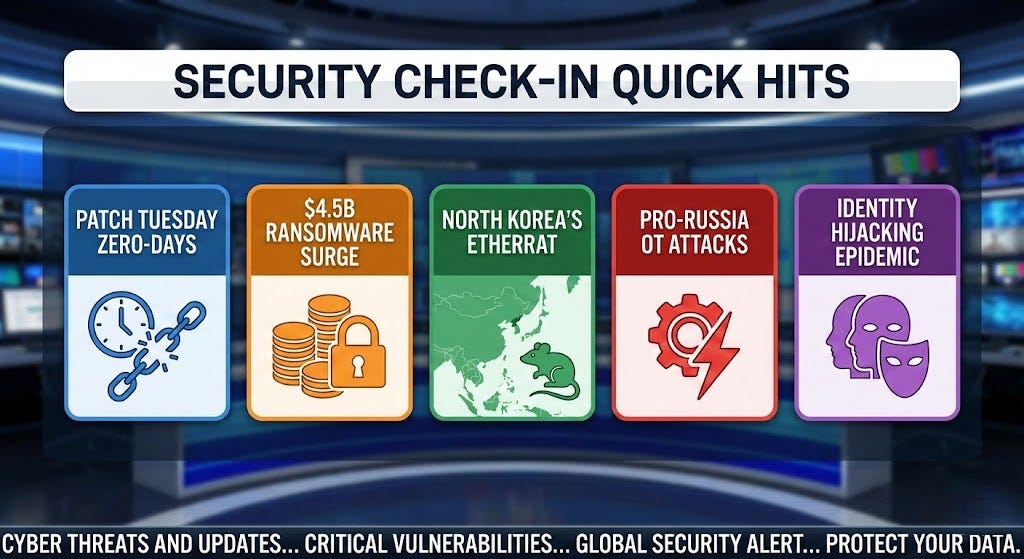
Microsoft’s December 2025 Patch Tuesday – Zero-Days and a Flurry of Fixes
In the world of cybersecurity, Patch Tuesday is like a monthly ritual, but December 2025’s edition from Microsoft has everyone talking. The tech giant rolled out updates addressing 56 to 57 vulnerabilities, including three actively exploited zero-days. One standout is CVE-2025-62221, a Windows privilege escalation flaw that’s already in the wild. Other highlights include fixes for Notepad++ hijacking attempts by Chinese threat actors and broader Windows and Office issues.
Why does this matter? Zero-days like these allow attackers to elevate privileges without detection, potentially leading to full system takeovers. With exploitation already underway, unpatched systems are sitting ducks. Arctic Wolf and Tenable have flagged these as high-impact, urging immediate action.
Key Takeaways:
Patch Now: Prioritize Windows 11 updates like KB5072033 and KB5071417.
Monitor for Exploitation: Use tools like honeypots to detect attempts.
Broader Lesson: Regular patching isn’t optional—it’s your first line of defense in 2025’s threat landscape.
Stay vigilant; this patch cycle underscores how even mature ecosystems like Microsoft’s remain prime targets.
Ransomware Rampage – 6,000 Attacks and $4.5B in Payments Signal a 50% Surge
2025 is shaping up to be the year of ransomware Armageddon, with reports highlighting nearly 6,000 incidents—a staggering 50% increase from prior years. Payments to attackers have ballooned to $4.5 billion, painting a grim picture of escalating cyber extortion. Cyble’s Global Cybersecurity Report calls it a “breaking point,” with data breaches exceeding 6,000 and dark web sales topping 3,000.
The surge isn’t just numbers; it’s sophisticated tactics. Japanese firms are reeling from prolonged disruptions, and global critical infrastructure is under siege. Pro-Russia groups are adding fuel to the fire with opportunistic attacks on sectors like energy and water.
Key Takeaways:
Backup and Isolate: Immutable backups are your ransomware lifeline.
Incident Response Drills: Test them regularly to minimize downtime.
Policy Push: Governments and orgs must rethink “no-pay” stances amid rising costs.
As ransomware evolves with AI assistance, 2025 demands proactive resilience over reactive fixes.
CVE-2025-55182 Under Active Exploitation – North Korea’s React2Shell Unleashes EtherRAT
It didn’t take long for CVE-2025-55182 to go from disclosure to widespread abuse. This vulnerability in React2Shell is being weaponized by North Korea-linked actors to deploy EtherRAT malware and cryptocurrency miners. Kaspersky’s Securelist reports honeypots lighting up with attacks, signaling rapid escalation.
Logistics firms are prime targets via GrayBravo’s CastleLoader, blending state-sponsored espionage with financial gain. This flaw allows shell command injection, bypassing traditional defenses.
Key Takeaways:
Update Dependencies: Scan for vulnerable React2Shell instances immediately.
Threat Hunting: Look for anomalous network traffic tied to DPRK tactics.
Global Alert: With exploitation growing, international sanctions on actors like these are crucial.
This incident highlights how quickly zero-days turn into global headaches—patch fast or pay the price.
Pro-Russia Hacktivists Target Critical Infrastructure with DDoS and Intrusions
Geopolitics meets cyber ops as pro-Russia hacktivists ramp up attacks on US and global critical infrastructure. Groups like NoName057(16), Cyber Army of Russia Reborn (CARR), and Z-Pentest are using tools like DDoSia for denial-of-service and intrusions into OT systems. CISA warns of opportunistic strikes on energy, water, and military sectors, often tied to the Russia-Ukraine conflict.
These actors leverage open-source tools for scanning and password spraying, with low sophistication but high impact due to indiscriminate targeting.
Key Takeaways:
Segment Networks: Isolate OT from IT to limit lateral movement.
Monitor Telegram Channels: Many ops are coordinated publicly.
Collaborate: Share intel via communities like SANS to stay ahead.
As hacktivism blurs with state actions, defending infrastructure requires a united front.
The Rise of Identity Hijacking – Bypassing MFA and Exploiting Cloud Access
Forget malware; 2025’s attackers are logging in legitimately. Misconfigured SSO, OAuth token abuse, and consent-phishing are the new normals, allowing invisible breaches without exploits. Experts warn that identity is the “new zero-day,” with logs showing attackers as valid users.
AI amplifies this, enabling automated phishing and malware creation, while Apple issues global spyware alerts.
Key Takeaways:
Zero Trust Identity: Enforce least privilege and token monitoring.
User Education: Train on phishing variants like AI-generated lures.
Audit Cloud Apps: Review permissions regularly.
Identity security isn’t a feature—it’s the foundation. Time to treat it as such.