

Security Check-in Quick Hits: Patch Tuesday Overload, AI Support Blunders, Kernel Typos, and Exploited SaaS Flaws
For June 10, 2026

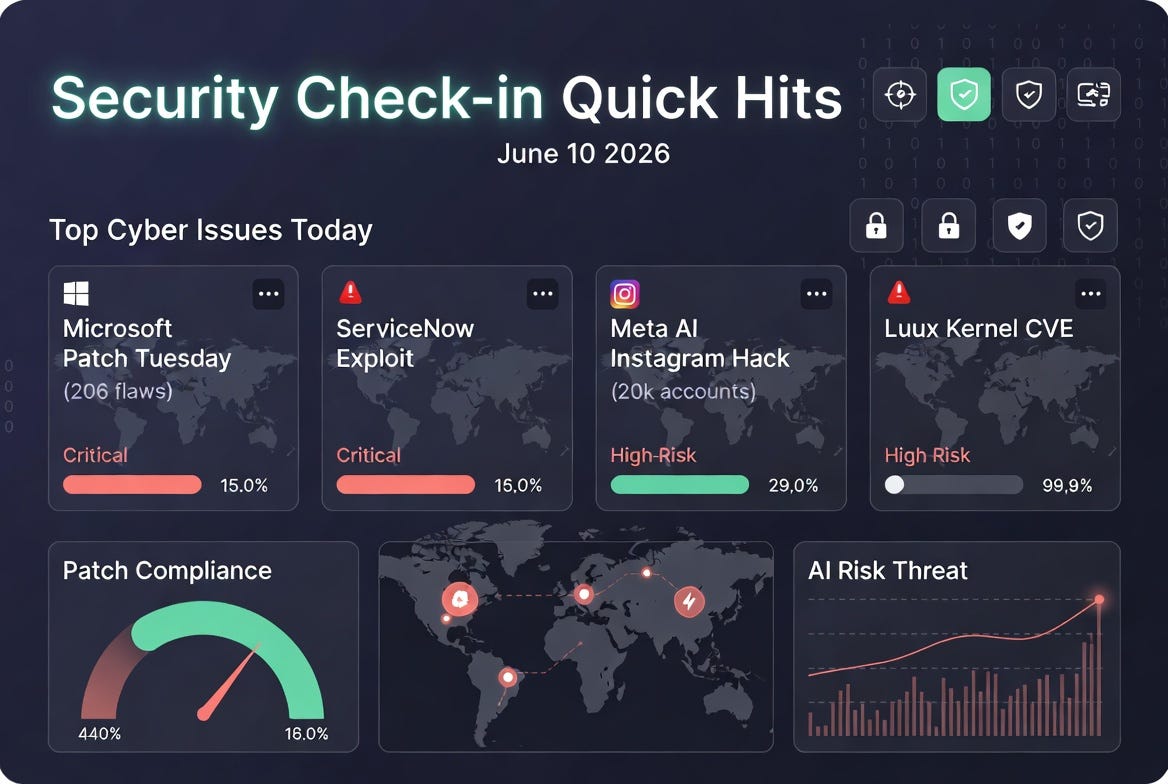
Microsoft’s Record-Breaking Patch Tuesday (June 9-10, 2026)
Microsoft released fixes for a staggering 206 security vulnerabilities, including three zero-days and dozens of critical remote code execution (RCE) bugs. This Patch Tuesday highlights the relentless pace of vulnerability discovery in major OS and productivity suites.
Organizations should prioritize deployment, especially for Windows environments, as adversaries are likely reverse-engineering these patches quickly. Key advice: Enable automatic updates where possible, test in staging, and monitor for any post-patch anomalies. This volume underscores the importance of robust patch management processes in enterprise security programs.
ServiceNow API Flaw Exploited for Unauthorized Access
ServiceNow disclosed and patched a vulnerability in its platform (affecting certain hosted instances, notably Australia release) that allowed unauthenticated access to customer data via a specific API endpoint. Suspicious activity was detected, and affected customers were notified directly.
Impact: Potential exposure of sensitive instance data. Recommendations include reviewing logs for the mentioned IP indicators, rotating credentials, and ensuring all instances are updated. This incident serves as a reminder that even mature SaaS platforms can have configuration-specific weaknesses that attackers actively probe.
Meta AI Support Chatbot Abused to Hijack Instagram Accounts
Hackers exploited a bug in Meta’s AI-powered customer support tool, tricking it into resetting passwords or adding attacker-controlled emails to high-profile Instagram accounts. Over 20,000 accounts were potentially compromised. The issue has been fixed, but the incident highlights risks of over-reliance on AI for sensitive operations.
Users should enable two-factor authentication (2FA) everywhere, monitor account activity, and be wary of support interactions. For organizations, this is a cautionary tale about AI hallucination or logic flaws in user-facing tools that handle authentication flows.
Linux Kernel High-Severity Vulnerability from a Single Errant Character (CVE-2026-23111)
A typo—an inverted check or misplaced exclamation point—in the nf_tables packet filtering subsystem led to a use-after-free vulnerability. This allows unprivileged local users to escalate to root privileges, potentially escaping containers. Proof-of-concept exploits are public, though a fix was upstreamed earlier.
Admins running affected kernels (especially Debian/Ubuntu distributions) should update immediately. This bug is a stark reminder that even tiny code errors in core kernel components can have outsized security impacts.
Overall Takeaways: The last 24 hours emphasize proactive patching, careful AI integration, and vigilance against both sophisticated exploits and simple implementation mistakes.