


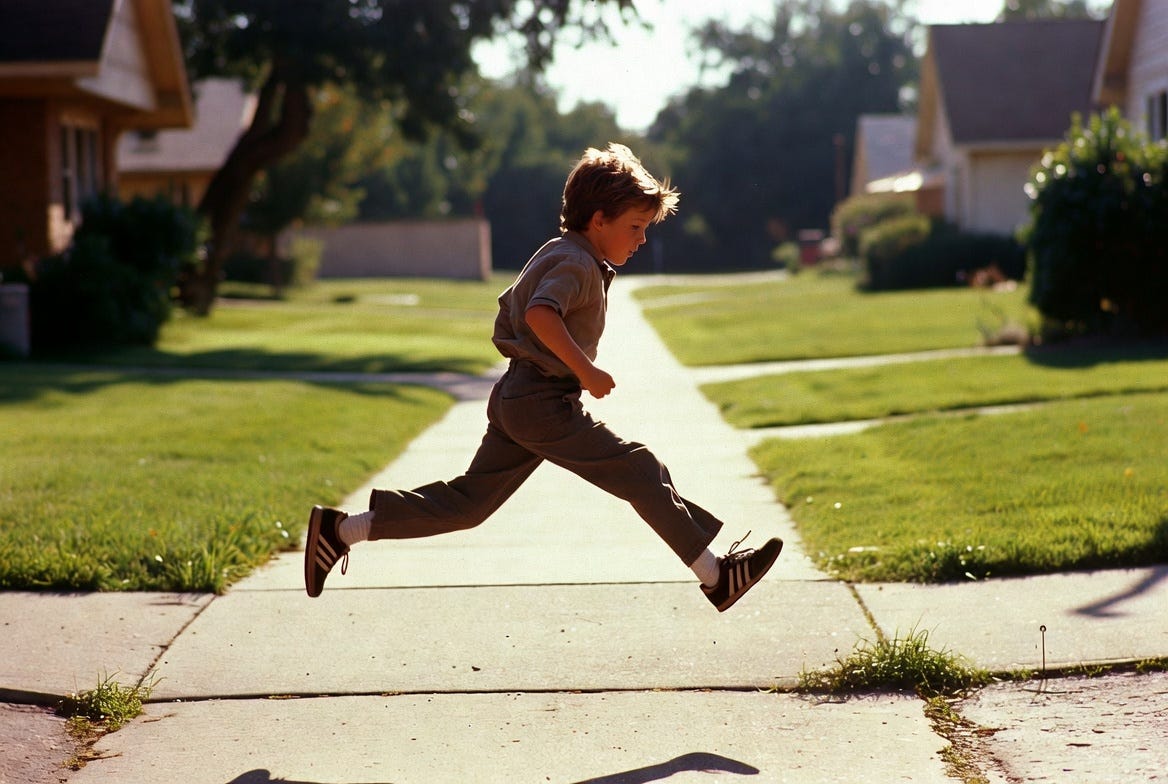
I can still hear it on summer afternoons. The chant rising from the sidewalk like it had always been there.
“Step on a crack… break your mother’s back.”
We didn’t just hear it. We believed it with the kind of certainty only children possess. One careless foot placement and the world would tilt. Your mom would be in a cast by dinner. Or worse. So we hopped. We stretched. We turned our feet sideways like awkward little ballet dancers, all to keep the universe from noticing us.
It wasn’t the only rule that felt carved into the air itself.
If you swallowed gum, it stayed in your stomach for seven years. Seven. A whole lifetime to a kid. I once spent an entire afternoon convinced I could feel it hardening somewhere near my ribs.
If you crossed your eyes too long they stayed that way. We tested this one constantly, snapping them back straight the second anyone older walked into the room.
Star light, star bright, first star I see tonight… We whispered it like a secret contract with the sky.
Say “Bloody Mary” three times in a dark bathroom and she would appear in the mirror. We never made it to three. The thrill was in getting close.
These weren’t suggestions. They were operating instructions for reality. And because we believed them, they worked. They made the ordinary sidewalk feel alive with consequence. They turned a piece of chewing gum into a seven-year sentence. They gave a child real power over the hidden machinery of the world.
We policed each other too. “You stepped on it!” someone would shout, and the guilty party would freeze, eyes wide, already imagining the phone call home. The magic only held if everyone agreed to keep the rules.
Then one day we didn’t.
We grew up and learned the explanations. Sidewalk cracks are just control joints for expanding concrete. Gum dissolves like everything else. Your eyes return to center because eye muscles are designed that way. Bloody Mary is a mirror and a flashlight and your own nervous system.
The rules lost their teeth.
Or so we thought.
Because here is the strange part. We never really stopped needing a little magic.
We just traded the old rules for new ones that feel just as true even when we know better.
“Everything happens for a reason.” We say it after the layoff, the diagnosis, the broken relationship. It is rarely provable. Sometimes it is not even comforting in the moment. But it gives the chaos a shape we can live inside.
“This too shall pass.” We whisper it at 2 a.m. when the house is quiet and the worry is loud. It has survived centuries because it works on something deeper than evidence. It keeps us moving when standing still feels safer.
“Build it and they will come.” Every creator, every founder, every writer who has ever published into silence has lived on this one. It is Field of Dreams logic dressed up for adults. It is almost certainly not how the world actually works. And yet without it, half the good things humans have made would never have been attempted.
“Show up every day and the work will meet you.” This one keeps the runners running, the chapters getting written, the apps getting shipped. It is not magic in the sense of something supernatural. It is magic in the sense that it creates an outcome that feels larger than the daily effort should reasonably produce.
We still knock on wood. We still say “God willing” or “knock on wood” or “don’t jinx it.” We still feel a small, ridiculous lift when we find a penny heads-up. We still make wishes on birthday candles and shooting stars and 11:11 on the clock.
The difference is that now we know these things are not literally true.
And we do them anyway.
That is the real magic.
Childhood superstitions gave us a way to feel agency in a world that often felt too big. Adult versions give us something just as necessary: the willingness to act as if meaning, effort, and hope are connected even when the data is inconclusive.
They keep us from becoming people who only move when the outcome is guaranteed. They protect a small corner of wonder that cynicism would otherwise claim. They let us parent with patience we do not always feel. They let us keep creating when the numbers say we should quit. They let us believe that small, faithful actions (a kind word, a daily run, one more paragraph, one more feature) might matter more than they appear to.
The kid who carefully stepped over every crack is still in here somewhere. He is the one who still feels a tiny spark of possibility when he sees the first star at dusk. He is the one who still believes, deep down, that the way we move through the world matters even when no one is watching.
So go ahead.
Step over the crack if you want to.
Make the wish.
Knock on wood.
The rules were never really about the cracks anyway.
They were about remembering that the world might still be listening.