

The Generative AI Streaming Mess: How We're Repeating the Same Mistakes
Prompt. Switch. Pay. Repeat. Welcome to AI’s ‘Which App Has the Good Stuff?’ Era.

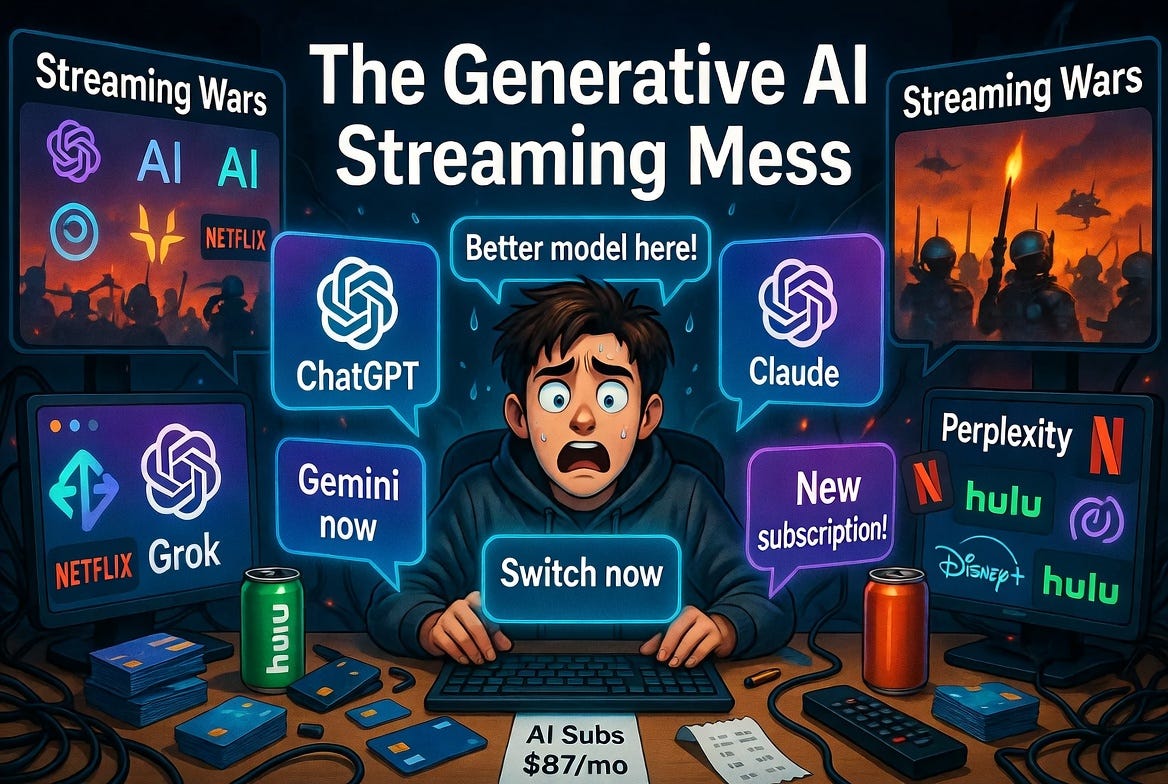
Remember when “Netflix and chill” was simple? One subscription, endless shows. Then came the great unbundling. Disney+, Hulu, Max, Paramount+, Peacock, Apple TV+... Suddenly you’re paying more than cable ever cost, juggling logins, and hunting for which service owns the rights to The Office this month. The streaming wars promised abundance. What we got was fragmentation, fatigue, and a worse experience for everyone.
Now, the exact same pattern is unfolding in generative AI—and it’s happening faster than you can say “prompt engineering.”
The New Subscription Roulette
Just a couple of years ago, ChatGPT felt revolutionary. One tool to rule them all. Today?
ChatGPT (OpenAI) for general use and creative writing
Claude (Anthropic) for thoughtful, long-form analysis
Grok (xAI) for real-time knowledge and unfiltered takes
Gemini (Google) for deep integration with search and Google ecosystem
Perplexity for research
Midjourney, DALL-E, Flux, Ideogram for images
Suno, Udio for music
And a dozen others for video, voice, code, agents...
Power users (the ones actually driving adoption) often maintain 3–5 active subscriptions. Each model has different strengths, different knowledge cutoffs, different personalities, different censorship levels, and wildly varying pricing tiers. Want the absolute best reasoning today? Better check Claude 4. Need fresh web data? Switch to Grok or Perplexity. Want beautiful images without heavy guardrails? Hop over to another tool.
Sound familiar? It’s the same reason people ended up with four streaming apps: no single service has everything.
The Fragmentation Tax
In streaming, the tax is money and time—$80–150/month and endless scrolling through apps.
In generative AI, the tax is cognitive load:
Context switching: Your prompt style that works perfectly on Claude falls flat on Gemini.
Inconsistent quality: One day Grok nails a complex analysis; the next, Claude does it better. You waste time testing.
Output lock-in: Generated content lives in different platforms. Good luck building a coherent workflow across five different chats.
Price creep: Individual model access is getting expensive. Companies are pushing “Pro” tiers at $20–200/month. The “freemium” model is shrinking as frontier labs chase revenue.
We’re recreating the bundle/unbundle cycle at hyperspeed. Remember when Disney pulled its content from Netflix to launch Disney+? AI labs are doing the same with their best models—walled off behind subscriptions while open-source alternatives scramble to catch up.
The Discoverability Nightmare
Streaming solved content overload with algorithms that mostly recommend the same 20 shows. Generative AI has an even harder problem: how do you discover what these models are capable of?
Most users barely scratch the surface. They use the default interface, generic prompts, and never realize that a different model or advanced technique could 10x their results. The “best” AI changes weekly based on new releases, benchmark drama, and surprise updates. It’s exhausting.
Meanwhile, the average person hears “AI is going to change everything” but experiences it as a confusing mess of apps, logins, and “try this new model” hype cycles.
Where This Ends
The streaming industry is now in the “consolidation” phase—bundling deals, mergers, and password-sharing crackdowns. AI feels like it’s still in the land-grab phase, but the backlash is coming:
User fatigue is real. Many are already cutting back to 1–2 favorite models.
Enterprise solutions will push unified platforms (think “AI operating systems” or agent frameworks that route to the best model behind the scenes).
Open-source momentum (Llama, Mistral, Grok’s open weights efforts, etc.) could prevent total enclosure, but even there we’re seeing fragmentation into specialized fine-tunes.
The winners won’t necessarily be the best models. They’ll be the ones that solve the interface problem—seamless access to multiple models, consistent UX, memory across sessions, and reasonable pricing.
The Hopeful Note
Unlike streaming, generative AI has a superpower: it’s not just delivering content—it’s creating it. The technology is improving so fast that the fragmentation pain might be temporary. But only if we learn from the streaming mess.
We don’t need 17 different AI chatbots any more than we needed 17 different ways to watch Succession. What we need is abundance without the exhaustion.
The next big leap won’t be a smarter model. It’ll be the platform that makes all the smart models feel like one.
Until then, enjoy managing your growing list of AI logins. Welcome to the new cable package—now with hallucinations included.
What do you think? Are you already feeling the AI subscription fatigue, or is the capability jump still worth the chaos? Drop your model rotation in the comments.