

Vibe Coding: Unleashing Creativity in the Age of AI
No CS degree? No problem. Just vibes, questionable life choices, and an AI that actually ships

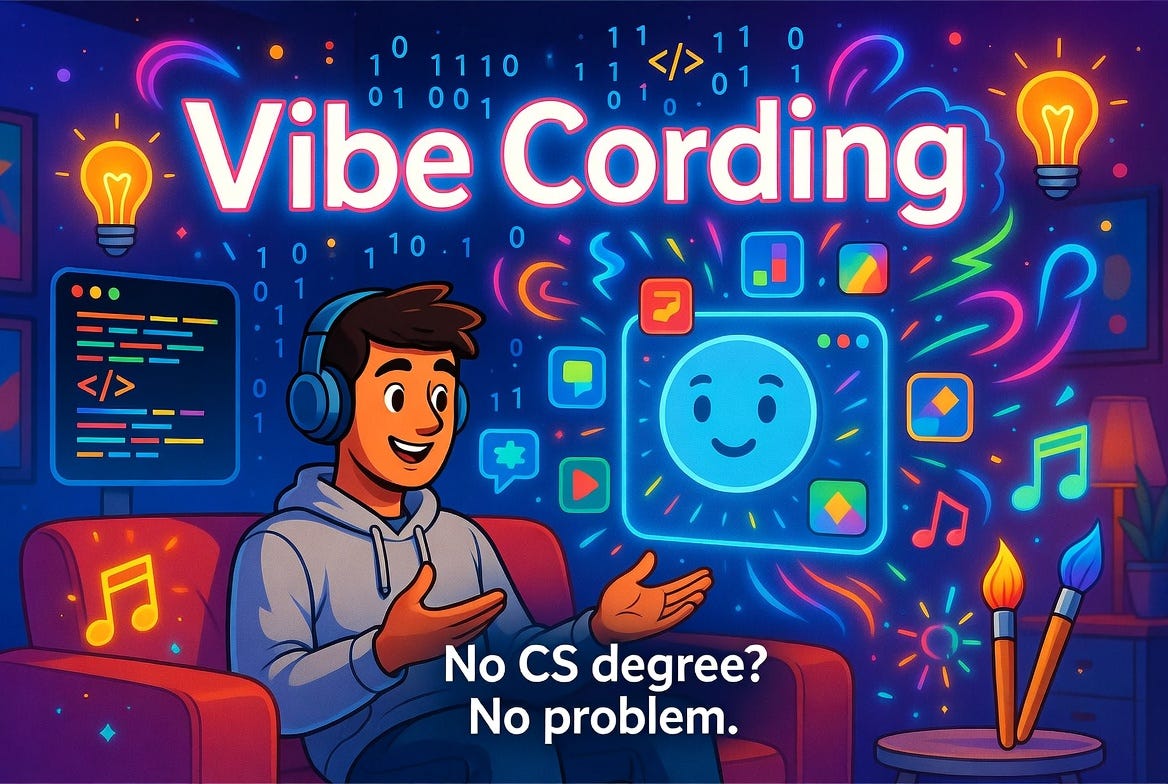
In the not-so-distant past, building software felt like an exclusive club. You needed years of classes, late nights debugging syntax errors, and a solid grasp of algorithms, frameworks, and best practices. If you had a brilliant idea for an app, a tool, or a digital experience, the path from spark to reality was paved with steep technical barriers. For creative minds—designers, entrepreneurs, artists, writers, and problem-solvers without formal developer training—this often meant shelving ideas or relying on expensive hires.
Enter vibe coding, a paradigm shift that’s changing everything.
Coined by AI pioneer Andrej Karpathy in early 2025, vibe coding is the practice of describing what you want in natural language—”the vibe”—and letting advanced AI models handle the heavy lifting of generating, refining, and iterating on code. You don’t write lines of code; you converse your vision into existence. You say things like “Build me a simple habit tracker with streaks, social sharing, and calming visuals,” and the AI delivers functional prototypes, often in minutes.
The Magic of Letting Go
Traditional coding demands precision and deep technical knowledge. Vibe coding invites flow. You embrace the exponential power of large language models (LLMs), focus on outcomes rather than implementation details, and iterate rapidly through conversation. It’s not about forgetting best practices entirely—it’s about prioritizing momentum, experimentation, and creativity over perfection from the start.
This approach is particularly transformative for creative people. Imagine:
A photographer who wants a custom portfolio site with AI-generated mood boards—no need to learn React or CSS frameworks.
A teacher designing an interactive learning tool for their students without studying database architecture.
An artist prototyping a generative installation or a small business owner creating a custom inventory system tailored to their quirky workflow.
Vibe coding removes the gatekeeping. You don’t need to “dig deep” into developer classes or spend months skilling up. Your creativity, domain expertise, and intuition become the primary drivers. The AI acts as an infinitely patient collaborator that translates your vision into working software.
Not a Bad Thing— A Democratizing Force
Critics sometimes dismiss vibe coding as “vibeslop”—sloppy, unmaintainable code produced by people who don’t understand what’s under the hood. And yes, for large-scale production systems with strict security, performance, or scalability needs, deep expertise still matters. But calling it inherently bad misses the point.
Vibe coding levels the playing field. It empowers a massive new wave of creators who were previously locked out. Non-technical founders, side-hustlers, researchers, and hobbyists can now turn ideas into reality faster than ever. This isn’t replacing skilled engineers; it’s expanding the ecosystem. Professional developers use it too—for rapid prototyping, exploring wild ideas, and accelerating mundane tasks.
The result? An explosion of solutions that simply wouldn’t exist otherwise. Niche tools addressing hyper-specific problems. Experimental art projects. Community-driven apps. Personal utilities that solve one person’s frustration and end up helping thousands. Innovation isn’t just faster—it’s more diverse, because it draws from a broader pool of human experience and imagination.
The New Era of Achievable Ideas
Before vibe coding, many ideas died in notebooks or “someday” lists due to technical friction. Now, the barrier is primarily imagination and iteration. You can build a weekend project that evolves into a startup. You can test concepts in hours instead of weeks. You can refine based on real feedback rather than theoretical planning.
This doesn’t mean the end of rigorous software engineering. It means a healthier division of labor: creatives and domain experts drive the “what” and “why,” while AI handles much of the “how,” and traditional developers focus on architecture, optimization, and complex systems where precision is non-negotiable.
Vibe coding celebrates the human element—intuition, taste, and vision—while offloading the mechanical. It’s joyful, accessible, and profoundly enabling.
Embrace the Vibe
If you’ve ever had an idea that excited you but felt intimidated by the technical hurdles, now is the time. Tools like Claude, Cursor, Gemini, Grok, and others make vibe coding more powerful every day. Start small. Describe your vision. Iterate. Ship something imperfect and improve it.
The future of building belongs to those who can dream vividly and communicate clearly. Vibe coding doesn’t lower standards—it multiplies creators. It turns more thinkers into makers. And in doing so, it unlocks a wave of solutions, experiences, and innovations that make the world a little more interesting.
What vibe will you code into reality today?