

When Your AI Eats Garbage: Real Examples of ROT Data Poisoning Your Results
How Redundant, Obsolete, and Trivial Data Turns Your Smart AI into a Confused Intern

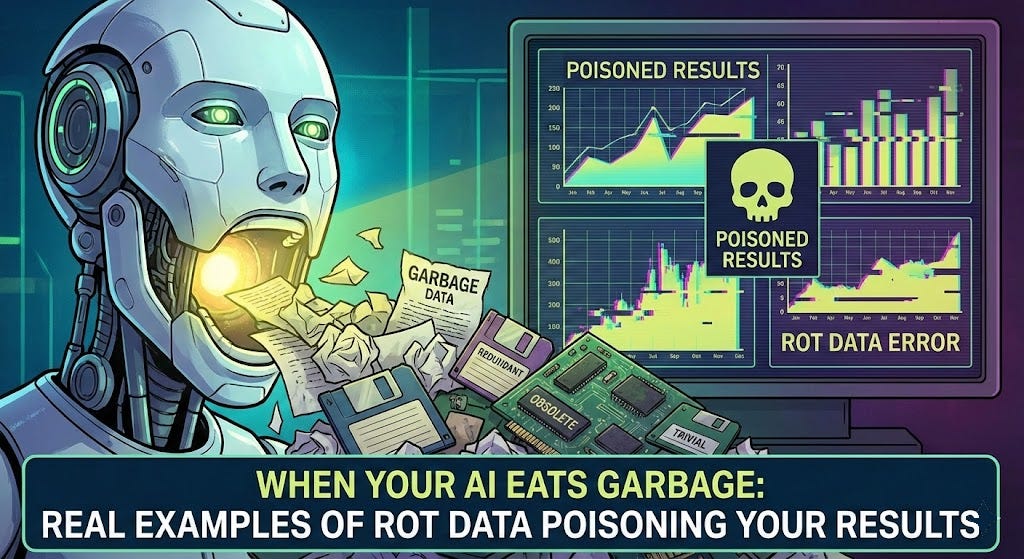
In my previous post, I discussed how AI’s reliance on biased and toxic data from public sources like Wikipedia and Reddit creates systemic problems. A subscriber asked an excellent question: what about the data sitting in your own company’s storage? Specifically, how does redundant, obsolete, and trivial (ROT) data impact the content your AI generates?
Turns out, it’s not just a problem—it’s a productivity and credibility disaster waiting to happen. Let me show you what I mean with real examples.
The ROT Problem: Your Data’s Dirty Secret
Before we dive into examples, let’s define what we’re dealing with. ROT data isn’t just old files you forgot to delete:
Redundant data: Multiple versions of the same document, duplicated records, or information stored in several places
Obsolete data: Outdated policies, deprecated product information, or expired regulations
Trivial data: Low-value content like test files, spam emails, personal photos, or draft documents never meant for production
Most organizations discover that 30-50% of their stored data falls into these categories. When you feed this mess to your AI, you’re essentially asking it to learn from a landfill.
Example 1: The Customer Service Chatbot That Lives in the Past
The Scenario: A financial services company deployed an AI chatbot to handle customer inquiries, training it on their entire document repository.
The ROT Problem: Their storage contained:
15 versions of their loan application process from the past decade
Obsolete compliance documents predating regulatory changes
Thousands of redundant email threads discussing policy changes that were later revised
The Impact: Customers asking about current loan interest rates received answers referencing products discontinued three years ago. The chatbot confidently cited a 4.5% rate that hadn’t existed since 2021, mixing it with current 7.2% rates. When customers called to complain, human agents had to explain that “the AI was confused.”
One mortgage applicant was told they needed to submit Form 1098-B, which the bank stopped using in 2019. They wasted two weeks trying to obtain a form that didn’t exist anymore.
The Cost: Beyond embarrassment, the company faced regulatory scrutiny for providing misleading financial information. They spent six months cleaning their data and retraining the model—work that should have been done before deployment.
Example 2: The Marketing AI That Recommends Dead Products
The Scenario: An e-commerce retailer implemented an AI system to generate product recommendations and email campaigns.
The ROT Problem: Their product database contained:
12,000 SKUs for discontinued items (never properly archived)
Redundant product descriptions from multiple migration cycles
Trivial test products created by developers during system upgrades
The Impact: The AI enthusiastically recommended a “bestselling wireless headphone model” that had been discontinued 18 months earlier. It generated compelling email copy highlighting features and customer reviews, complete with a “Shop Now” button linking to a 404 error page.
Even worse, the system occasionally pulled pricing data from old test records, advertising $5,000 laptops for $499.99. While customers loved clicking those emails, fulfillment couldn’t honor the prices, creating customer service nightmares and damaging brand trust.
The Measurement: Their email click-through rates actually increased (people love impossible deals), but their conversion rate plummeted by 47% and customer complaints tripled. The AI was technically successful at engagement—just for all the wrong reasons.
Example 3: The Healthcare AI That Mixes Current and Outdated Protocols
The Scenario: A hospital system trained an AI assistant to help staff access treatment protocols and medication guidelines.
The ROT Problem: Their clinical database contained:
8 versions of COVID-19 treatment guidelines spanning 2020-2023
Obsolete surgical procedures replaced by newer techniques
Redundant drug interaction databases from different acquisitions
Test cases and draft protocols never officially approved
The Impact: A nurse querying medication dosages for a pediatric patient received guidance mixing current recommendations with protocols from 2019. The AI pulled dosing information from an obsolete guideline while citing safety warnings from current standards—creating contradictory advice.
In another case, the system recommended a surgical approach that had been superseded by a less invasive procedure two years prior, citing “best practices” from redundant historical documents that should have been archived.
The Reality Check: Healthcare providers quickly learned to distrust the system, defaulting back to manual lookups. The AI meant to save time actually added verification steps, slowing workflows instead of accelerating them. The hospital pulled the system after three months.
Example 4: The HR Chatbot That Cites Policies From Three Acquisitions Ago
The Scenario: A technology company deployed an AI to answer employee questions about benefits, policies, and procedures.
The ROT Problem: Through multiple acquisitions and policy updates, their HR repository contained:
Vacation policies from four different acquired companies
Obsolete handbook versions dating back seven years
Redundant memos announcing policy changes (but not always the final policies)
Draft policies that were never implemented
The Impact: An employee asked about parental leave and received information citing three different policies: 6 weeks (current), 12 weeks (obsolete), and 16 weeks (from an acquired company’s old handbook). The AI confidently averaged them and suggested “approximately 11 weeks may be available.”
Another employee inquired about remote work policies and got an answer combining the pre-pandemic policy (office required 5 days/week), the pandemic emergency policy (100% remote), and the current hybrid model (3 days in office). The result? Useless guidance that contradicted itself within the same paragraph.
The Domino Effect: HR staff spent more time correcting the AI’s mistakes than they would have answering questions directly. Employee trust in company communications eroded as people realized they couldn’t rely on official sources. The HR team eventually disabled the chatbot and spent $200,000 on a data cleanup project.
Example 5: The Legal Research AI That Cites Overturned Precedents
The Scenario: A law firm implemented an AI tool to assist with legal research and memo drafting.
The ROT Problem: Their document management system contained:
30 years of legal briefs, many citing cases later overturned
Redundant copies of case files stored by multiple attorneys
Draft briefs and research memos never finalized
Trivial administrative documents mixed with case files
The Impact: An associate used the AI to research employment discrimination law. The system generated a memo citing a precedent-setting case—that had been overturned five years earlier. The AI pulled from an old brief stored in the system and didn’t recognize that subsequent documents contradicted it.
The memo went to a senior partner, who caught the error before it reached the client. But that near-miss revealed a deeper problem: the firm’s AI was essentially trained on a mix of current law and historical legal theories that were no longer valid.
The Professional Risk: In legal work, accuracy isn’t just important—it’s everything. One incorrect citation can undermine an entire case or trigger malpractice claims. The firm had to implement a complete overhaul of their data management, archiving obsolete materials and clearly tagging superseded legal theories.
Example 6: The Sales AI That Pitches Expired Promotions and Wrong Prices
The Scenario: A B2B software company created an AI sales assistant to help reps prepare proposals and answer prospect questions.
The ROT Problem: Their CRM and document storage included:
Pricing sheets from every quarter for the past 8 years
Expired promotional offers and discounts
Redundant contract templates from different sales leaders
Trivial test data from sales training exercises
The Impact: A sales rep asked the AI to generate a proposal for a prospect. The system pulled pricing from a 2021 rate card (30% lower than current rates), combined it with a promotional discount that expired 14 months ago, and referenced product features from a version that had been discontinued.
The rep sent the proposal without careful review. When the prospect tried to move forward, the pricing team flagged the 40% discrepancy. The company had to choose between honoring an unprofitable price or backing out and looking incompetent. They honored it—and lost $47,000 on that deal alone.
The Pattern: This happened seven times before someone investigated. The AI wasn’t hallucinating—it was accurately retrieving obsolete information that should never have been available. Each incident damaged customer relationships and profit margins.
The Common Thread: Garbage In, Garbage Out (But Confident Garbage)
Notice the pattern across these examples? The AI didn’t fail because it was poorly designed or lacked sophistication. It failed because it did exactly what it was supposed to do: learn from the data provided.
The problem is that ROT data looks legitimate to an AI. A 2019 policy document and a 2024 policy document have the same structural characteristics. Without proper data governance—archiving old versions, marking obsolete content, removing redundant copies—the AI treats everything as equally valid.
And here’s what makes it worse: AI doesn’t know it’s wrong. It generates confident, well-formatted, professional-sounding content based on garbage inputs. Humans can sometimes recognize that something “feels off” about outdated information. AI just serves it up with a digital smile.
The Solution Starts Before Training
If you’re planning to deploy AI that learns from your corporate data, here’s the hard truth: you need to clean your house first.
Start with a data audit:
Identify how much ROT data exists (most companies are shocked)
Implement retention policies with actual enforcement
Archive or delete obsolete information
Deduplicate redundant records
Remove trivial data that adds no value
Build governance into the workflow:
Require version control and sunset dates for policies
Tag documents with effective dates and supersession information
Create clear processes for archiving outdated content
Separate production data from test/draft materials
Design AI with data quality in mind:
Implement data freshness signals that prioritize recent information
Use metadata to filter obsolete content during training
Build in validation steps that flag contradictory outputs
Create feedback loops where errors trigger data quality reviews
The Bottom Line
Your AI is only as good as the data it learns from. Biased Wikipedia and toxic Reddit content create one set of problems, but ROT data in your own storage creates another—and it’s entirely preventable.
Every example I shared represents real money lost, relationships damaged, and trust eroded. In some cases, it created legal liability or regulatory exposure. And in every case, the problem wasn’t the AI—it was the data hygiene practices (or lack thereof) that came before.
Before you train your next AI model on corporate data, ask yourself: would you feel confident having a new employee learn from this mess? If the answer is no, don’t expect your AI to do any better.
Because when your AI eats garbage, it doesn’t just get sick—it confidently serves that garbage to your customers, employees, and partners. And unlike a human who might hesitate or ask for clarification, AI just keeps feeding people from the dumpster.
Clean your data first. Train your AI second. Your reputation depends on it.
What ROT data disasters have you encountered? Have you seen AI systems produce confident but wrong answers because they learned from outdated information? Share your experiences in the comments—I’m building a collection of real-world cases to help others avoid these pitfalls.