

Why Your Classical AI Agents Need a Quantum Sidekick
Schrödinger's Agent: Alive, Dead, and Crushing Optimization Problems Before You Even Open the Box

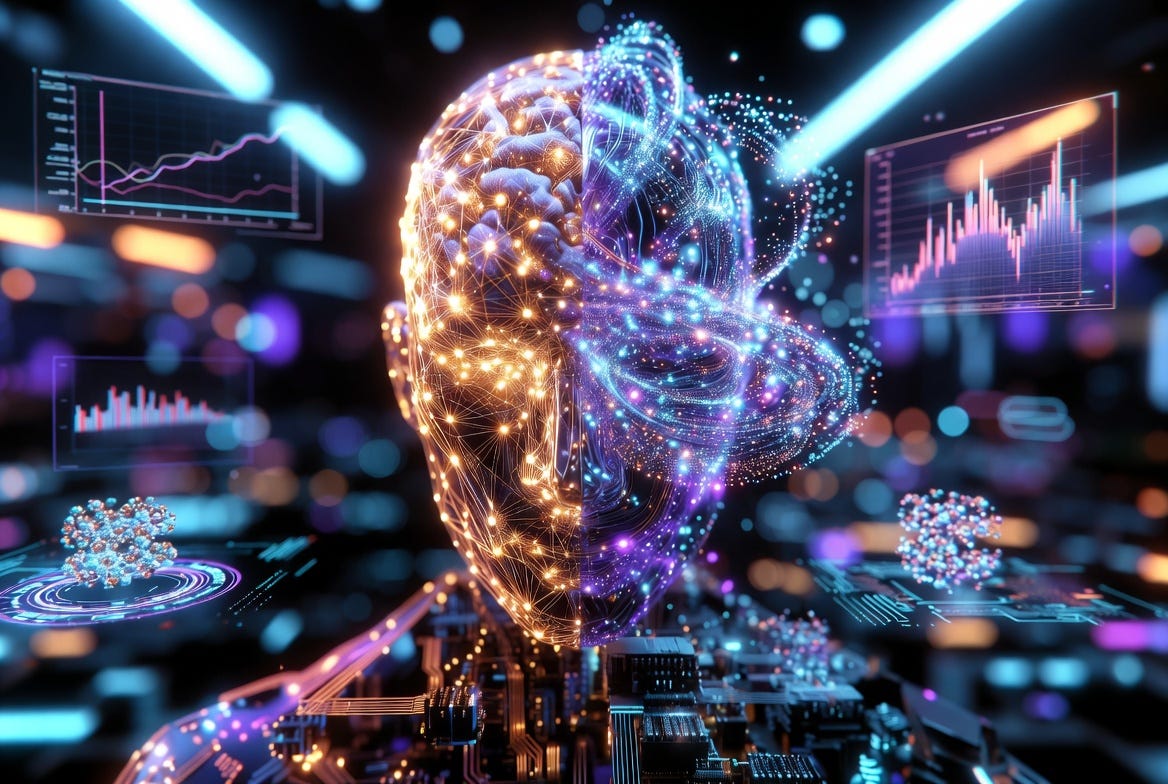
In the world of AI agents, we’re hitting walls. Classical systems excel at pattern recognition, natural language, and scaling on GPUs, but they struggle with exponential complexities in optimization, simulation, and high-dimensional search spaces. Enter hybrid quantum-classical AI: the ultimate tag-team where reliable classical brains pair with quantum weirdness for supercharged problem-solving.
This isn’t sci-fi hype—it’s the near-term reality of NISQ (Noisy Intermediate-Scale Quantum) devices working in tandem with classical hardware. Hybrid architectures let classical AI agents delegate the “impossible” subproblems to quantum processors or simulators, then integrate the results for practical, actionable intelligence.
The Core Architecture: Classical Brains Meet Quantum Muscle
At a high level, hybrid systems follow a variational hybrid quantum-classical loop:
Classical Preprocessing & Orchestration: The AI agent (often powered by LLMs, reinforcement learning policies, or multi-agent frameworks) analyzes the problem, decomposes it, and prepares data for quantum encoding (e.g., via amplitude or angle encoding).
Quantum Subroutine Execution: Small quantum circuits handle tasks like:
Variational Quantum Eigensolver (VQE) for molecular simulations or energy minimization.
Quantum Approximate Optimization Algorithm (QAOA) for combinatorial problems like routing, scheduling, or portfolio optimization.
Quantum sampling for probabilistic inference or feature mapping in high dimensions.
Measurement & Classical Post-Processing: Quantum measurements yield probabilistic results. Classical optimizers (e.g., gradient descent, Adam) tweak variational parameters and iterate. Error mitigation and hybrid feedback loops refine the process.
Agentic Orchestration Layer: Modern setups use agent frameworks (LangGraph, AutoGen-inspired, or specialized quantum agents) to manage workflows, decide when to invoke quantum resources, handle noise/decoherence, and integrate with classical tools. Think of it as a smart dispatcher: “This supply chain routing? Send to QAOA. Molecular docking? VQE time.”
Example Stack:
Classical: PyTorch/TensorFlow for neural nets, Autoencoders for dimensionality reduction.
Hybrid Bridge: PennyLane, Qiskit, or Cirq with classical optimizers.
Quantum Backend: Simulators (for dev) or real QPUs from IBM, IonQ, Quantinuum, etc., via cloud.
Agent Layer: Multi-agent systems coordinating perception → planning → quantum action → reflection.
In latent space hybrids, a classical autoencoder compresses high-dimensional observations, feeding a quantum policy network (e.g., in reinforcement learning) for better exploration in complex environments.
Real-World Problem-Solving Wins
Optimization & Logistics: Classical agents struggle with NP-hard problems at scale. Quantum subroutines shine in finding near-optimal solutions faster for fleet routing, financial portfolio balancing, or drug discovery molecule search.
Scientific Simulation: Hybrid agents simulate quantum systems (chemistry, materials) natively. Classical AI handles the big picture; quantum tackles the entangled electron behaviors.
Reinforcement Learning Agents: Quantum-enhanced policies explore action spaces more efficiently, especially in latent representations, leading to faster convergence in robotics or game AI.
Machine Learning Acceleration: Quantum kernels for SVMs or feature maps in QML models boost classification in sparse, high-dimensional data—think cybersecurity anomaly detection or personalized medicine.
Early platforms like Kipu Quantum’s Agentic Quantum Computing demonstrate orchestration across classical LLMs and multiple QPUs for real hybrid workflows.
Challenges on the Horizon (And How Agents Help)
Noise & Scalability: NISQ devices are error-prone. Hybrid designs mitigate via classical error correction and variational methods.
Interface Overhead: Data shuttling between classical and quantum adds latency—solved by tight integration in modern hybrid supercomputer architectures (CPU/GPU + QPU layers with real-time control).
Accessibility: Cloud QPUs and simulators lower the barrier. Agents abstract the complexity: “Just tell me the goal.”
Talent & Integration: Requires quantum-aware AI developers. Frameworks are maturing rapidly.
The Future: Agentic Quantum-Classical Superintelligence
Imagine autonomous AI agents that dynamically route subproblems—quantum for intractable simulations, classical for everything else—evolving policies in real-time. This powers breakthroughs in climate modeling, secure cryptography (post-quantum readiness), personalized AI, and beyond.
For security pros and PMs (like those building in Microsoft ecosystems), hybrid quantum could supercharge threat detection, zero-trust optimization, or even AI agent hardening against adversarial attacks.
Conclusion: Time to Get Hybrid
Hybrid quantum-classical AI isn’t replacing classical agents—it’s amplifying them into something far more powerful. The next generation of intelligent agents will think classically, compute quantumly, and solve problems we once deemed intractable.
Start experimenting today with simulators and libraries like PennyLane. The qubit is calling.
What hybrid quantum use case excites you most for AI agents? Drop a comment or connect on X @rodtrent.