

Zero-Trust Is Dead. Long Live Zero-Trust Agents.
Static zero-trust policies can’t keep up. Here’s how self-verifying AI agents fix the problem.

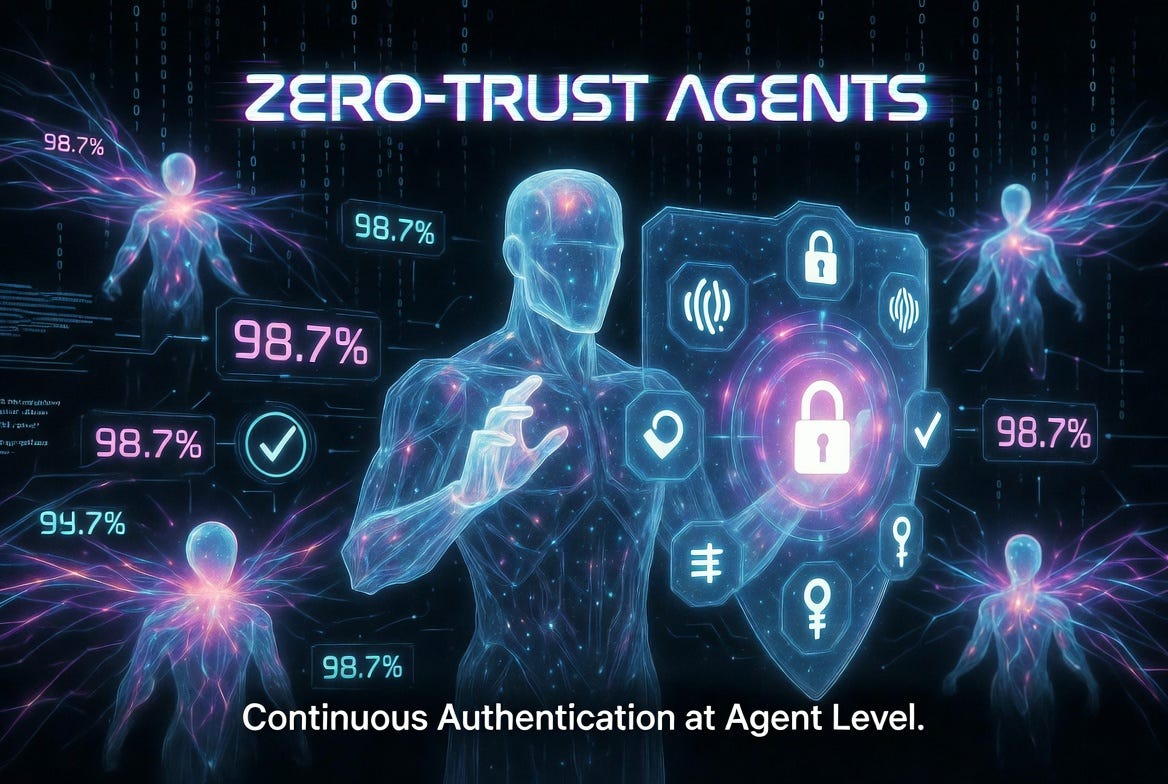
For years, zero-trust has been the gold standard in cybersecurity: “never trust, always verify.” Organizations ripped out implicit trust, enforced least-privilege access, and wrapped every user, device, and workload in continuous checks. It worked—until it didn’t.
Today’s environments move too fast. AI agents, autonomous workflows, microservices that spin up and down in seconds, and supply-chain attacks that compromise legitimate credentials have exposed the fatal flaw in classic zero-trust: it’s still mostly static. Policies are written by humans, enforced by rigid rules engines, and updated on human timescales. Attackers and legitimate agents now operate on machine speed. The old model is dead.
The future belongs to Zero-Trust Agents—autonomous, self-verifying AI entities that perform continuous authentication and authorization at the agent level, not just the user or device level.
Why Traditional Zero-Trust Falls Short
Policy lag: A new vulnerability appears; it takes days or weeks for policy updates to propagate.
Context blindness: Rules can’t natively understand intent, behavior drift, or subtle anomalies in real time.
Agent explosion: Enterprises now deploy thousands of AI agents that act on behalf of users or processes. Treating them as simple “service accounts” reintroduces implicit trust.
Identity fatigue: MFA, device posture, and network segmentation help, but they don’t answer the harder question: Should this agent be doing this action right now, given everything that has happened in the last 30 seconds?
We need authentication and authorization that lives inside the agent itself—continuous, adaptive, and self-enforcing.
Enter Zero-Trust Agents
A Zero-Trust Agent is an AI-powered entity that:
Continuously proves its own integrity and intent.
Maintains a dynamic trust score that decays in real time.
Carries cryptographically signed attestations of its actions and reasoning.
Operates within a sandboxed “trust boundary” that can instantly revoke privileges.
These agents don’t just request access—they prove they deserve it at every step, using behavioral analysis, cryptographic proofs, and peer validation.
Continuous Authentication at the Agent Level
Forget periodic token refreshes. Zero-Trust Agents run a persistent verification loop:
Self-Attestation: Every few seconds (or before every high-risk action), the agent generates a fresh cryptographic proof of its code integrity, model weights (if applicable), runtime environment, and current behavioral fingerprint.
Behavioral Biometrics for Agents: Just as we analyze keystroke dynamics for humans, agents are fingerprinted by their decision patterns, API call sequences, data access graphs, and even natural language reasoning traces.
Just-in-Time Micro-Authorizations: Instead of broad JWT tokens, agents request scoped, time-bound “action tokens” backed by real-time risk signals. An agent updating a database might get a 10-second token that only allows one specific SQL statement.
Mutual Agent Verification: Agents validate each other in a mesh. A procurement agent only accepts data from a supplier agent if the latter’s trust score and recent audit log pass validation.
Human-in-the-Loop as Exception: Escalation to a human only occurs on high-uncertainty decisions—most routine work stays fully automated and fully verified.
This turns authentication from a gate at the perimeter into a living property of the agent.
Architecture Blueprint
Here’s a practical reference architecture:
text
[External Identity Provider + Threat Intel]
               ↓
[Agent Identity Service] ←→ [Central Trust Orchestrator]
               ↓
[Agent Runtime Sandbox]
   ├── Policy Engine (dynamic, ML-driven)
   ├── Self-Verification Module (code + behavior + model attestation)
   ├── Cryptographic Ledger (immutable action log)
   ├── Peer Validation Mesh
   └── Revocation & Quarantine Bus
               ↓
[Protected Resources] (APIs, databases, tools)
Key Components:
Agent Identity Service: Issues long-lived “agent passports” (cryptographic identities) tied to the agent’s code hash, owner, and purpose. Uses SPIFFE/SPIRE or similar under the hood.
Trust Orchestrator: Real-time brain. Ingests signals from SIEM, UEBA, vulnerability feeds, and the agents themselves. Outputs a numeric trust score (0–100) that decays exponentially without fresh proofs.
Self-Verification Module: Embedded in every agent. Uses TPMs, confidential computing (e.g., AWS Nitro, Azure Confidential VMs), and model provenance tools (e.g., Hugging Face’s model cards + signatures) to prove “I am who I say I am and I’m behaving normally.”
Action Ledger: Every decision is logged with a zero-knowledge or selectively disclosed proof so auditors can verify without seeing sensitive data.
Quarantine Bus: When trust drops below threshold, the orchestrator instantly revokes tokens, isolates the agent, and spins up a clean replacement if needed.
Implementation tip: Start small. Wrap existing RPA bots or LangChain/LlamaIndex agents with a lightweight verification wrapper before rebuilding from scratch.
Real-World Benefits
Speed + Security: Agents act in milliseconds while maintaining stronger guarantees than static policies.
Auditability: Every action has a verifiable chain of reasoning and proofs—perfect for regulated industries.
Resilience: Compromised agents are detected and contained faster than traditional monitoring can react.
Scalability: Human security teams focus on exceptions and strategy instead of chasing policy updates.
Early adopters in fintech and healthcare are already seeing 40-60% reductions in manual access reviews and dramatically faster incident containment.
Challenges and the Road Ahead
This isn’t trivial. We need:
Standardized agent attestation protocols (building on efforts like OpenID for Verifiable Credentials and confidential computing standards).
Better model behavioral analysis tools.
Cultural shift: Developers must treat agent identity and verification as first-class concerns.
Performance overhead management—though modern hardware acceleration for zero-knowledge proofs and confidential enclaves is closing this gap rapidly.
Zero-trust isn’t going away. It’s evolving from a set of static network and identity policies into a living, agent-native property of autonomous systems.
The perimeter is gone. The new perimeter is the agent itself—and it must prove its trustworthiness continuously.
Long live Zero-Trust Agents.
What do you think? Are your organizations already experimenting with agent-level verification, or is this still 12–18 months out? Drop your thoughts in the comments.